Showing posts with label protest. Show all posts

Friday, 18 July 2008

Babies, Caravans, Betting and Bombs


posted by Kathy

Babies and bombs may seem a surprising combination but the company Clarion Events is happy to sponsor both. They run lots of exhibitions including Baby Shows, antiques fairs and The Spirit of Christmas exhibition.

I've just received the latest email from Campaign Against Arms Trade. And I learn that Clarion Events has extended its range. It's concerned, according to its website, with growth areas. So perhaps it's not surprising that the company has moved into arms sales.

Clarion Events has bought the company DSEi from Reed Elsevier, who seem to have responded to ethical objections to DSEi's area of expertise. DSEi runs regular arms fairs in Britain where states - including some of the most repressive states in the world - can buy weapons and torture equipment from arms dealers. The event is heavily policed and protestors are regularly arrested. This happened to 66-year-old pacifist Gwyn Gwyntopher who was dragged in handcuffs across the concrete of a railway station (although she had a valid ticket) in case her presence and placard cause offence to any arms dealers. She was later acquitted of trespass.

Campaign Against Arms Trade suggests that people might like to write to Simon Kimble, the Chief Executive of Clarion Events expressing their concerns about arms fairs. They provide a helpful form HERE. The address of Clarion Events is Earls Court Exhibition Centre, Warwick Road, London SW5 9TA.

The video shows Mark Thomas considering the arguments in favour of arms sales.


Thursday, 29 May 2008

Report from the protest

Posted by Rhiannon

I attended yesterday's protest in support of Hicham Yezza and academic freedom (in no particular order; for details of the events which led to this protest, see my previous post). We began, in the pouring rain, with academics and students reading the document which, downloaded and emailed, led to the inital arrests. I have to say, it seems to be very stirring stuff, from what I heard through the rain: if you're holding a secret meeting in new house, remember that the walls are thin so keep your voice down. If you want to recruit a new agent, find out what they'd like before deciding what to offer them. Try talking to people who work in coffee shops.

We were then addressed by Alan Simpson MP, who in a moment of daring spoke from the forbidden balcony of the Hallward Library. He actually spoke very well--gathering lots of applause--telling us that he too objected to the way things have been handled, especially the time it took to establish that the download was legitimate research. He made it sound like he is doing everything he can to help, though not knowing what's possible I find it hard to judge the truth of this.

Finally, we marched--silently, gagging ourselves to make visible the silence and suggest that we are being silenced by this attack on academic freedom, and also because it's still exam time--round the Portland building to Trent (Google Maps should give you an idea: down Portland Hill and along East Drive to the courtyard of the Trent Building). Once in Trent courtyard, we stood as a mass, in perfect silence for perhaps five minutes, perhaps more: I was very caught up in the moment, in the expectant gathered waiting. That makes it sound like Meeting for Worship, which it was in as much as the silence was powerful and expectant, even gathered, and not in as much as the purpose was very different.

I don't know how many people were there. It's very hard to judge numbers from the middle of the crowd, so I'll leave guesses to others. I did, though, recognise several fellow students and a few members of staff from my departments, and I was heartened to see people coming to the windows as we stood in Trent Courtyard with the cameras whirring, the birds singing, and an unanswered telephone going somewhere in the background.

Other reports:
Worker's Liberty,
Asian Image,
Indymedia,
photos can be found here (you may even recognise my hat),
follow more news stories here.

Sunday, 25 May 2008

'Terror' on campus?

Recently, Rizwaan Sabir (a postgraduate student at the University of Nottingham) and Hicham Yezza (a former student and current employee of the University, and a peace activist) were arrested on suspicion of owning 'terrorist materials'. It was widely reported in the local news. Their 'crime'? Downloading and emailing an al-Qaeda handbook which was freely avaliable on the web, including from a US government website, as part of Rizwaan Sabir's politics research. The Muslim News seems to have the best details.

There are several aspects to this story which I find deeply disturbing. It's clearly a misuse of terror legislation and an attack on academic freedom, with racist overtones: Alf Nilsen, a research fellow in law and social sciences, is quoted in the Times Higher Education Supplement as saying that it is "occurring in tandem with several other attempts by UK authorities to increase surveillance of the academy and, in particular, non-Western students and staff". A police officer is being reported as saying that "This would never have happened if he had been a white student."

A protest will be held on Wednesday 28th May at 2pm outside the Hallward Library on campus. Academics from the University of Nottingham will be doing a public reading of the research material that led to arrests under the Terrorism Act, followed by a silent protest where students and academics will symbolically gag themselves to object to the attack on academic freedom.

Secondly, Hicham Yezza has been re-arrested on immigration charges- despite having been in the UK for 13 years as a student and now employee of the university, who are meticulous about checking visas and paperwork. An attempt is being made to deport him, probably to make him appear guilty. A corresponding campaign is being mounted, which has already been picked up by the Independent on Sunday: if it is to succeed, it needs to act quickly, as the deportation could happen as soon as Tuesday 27th May if the current appeal fails.

Like the attack on academic freedoms, these deportations seem to be getting more common. We need to act. Please take as many of the following actions as you can:
- attend the protest, outside the Hallward Library on Nottingham University Campus at 2:00pm on Wednesday, 28 May;
- circulate the press release about Hicham Yezza, by word of mouth, blogging, writing, and whatever other method you like;
- write to your MP asking them to write to the Immigration minister, Liam Byrne, in support of Hicham Yezza.


(further information and corrections welcomed)

Tuesday, 20 May 2008

Military celebrations


posted by Kathy

It sounds as though celebrating the military is to become a compulsory part of life. I've blogged about this, in a personal capacity, elsewhere but I paused before posting to a blog labelled "Quaker".

I haven't read the whole document yet as it's a large pdf file but I've seen a number of the proposals (which havthe e support of the government) which are widely reported in the press. There are, so far as I can see, three categories, although these sometimes overlap.

First there is a concern to make life easier for serving soldiers, particularly serving soldiers in uniform and those returning from war. It wouldn't be realistic to expect this concern to lead the government to disengage from war at once, disband the army and compensate ex-soldiers but I note that there's more interest in homecoming parades (which councils will be expected to organise) and discounts for serving soldiers in uniform in shops and at sporting events. It's disappointing that there's nothing to meet real concerns of soldiers about housing and health treatment - and nothing about the high level of homelessness and mental health problems among soldiers who have left the army. There's a provision which would make it a crime to discriminate against a soldier in uniform that I'll discuss later.

Then there are provisions to celebrate and glorify the army. Soldiers are to be more visible. Military parades, tattoos and so on will become a more frequent part of life and will be covered on television. There will be a new bank holiday (probably in June) to celebrate the armed services and veterans.)

Finally there are the provisions that will affect people's rights, especially the rights of children and anti-war activists. "Military awareness" will become part of the national curriculum and state schools will be encouraged to set up cadet corps for their pupils. No-one is talking about a right of conscientious objection from military awareness courses. Quakers and others may feel worried about the effect of this increased emphasis on the military in schools. It's bad enough already. In addition, we should watch out for the laws which make discrimination against serving soldiers a crime - and the laws which deal with abusing soldiers.

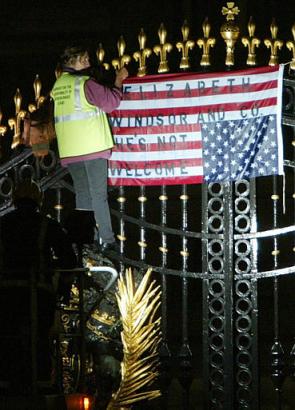
Obviously the first response of Quakers may be to say, "But we'd never do that." Nonetheless, laws are often used against peace protestors in surprising ways. I recall when Lindis Percy was accused of racial abuse for mistreating a United States flag. Will these laws be used against peace protestors. I've stood outside Chetwynd Barracks with other members of Beeston Quakers and anti-war protestors. I've handed out leaflets and spoken to soldiers through a megaphone. Would this be treated as discriminatory or abusive? We won't know until we see the law and how it is used.

The press has, on the whole, greeted the new proposals with enthusiasm and Gordon Brown has indicated that they will become law. These could be difficult days for peace-makers.


Saturday, 17 May 2008

Saying "no" to war


posted by kathy


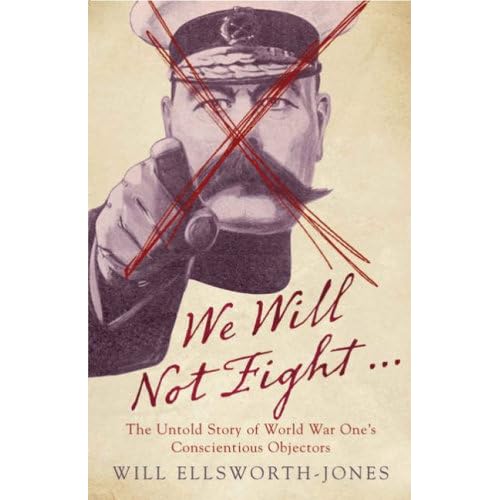
A review in today's Guardian reminded me of the history of pacifist conscientious objection - and how difficult it was. One of the books discussed, We Will Not Fight by Will Ellsworth-Jones, looks at the case of Bert Brocklesby, whose two brothers were at the front. War was against Bert's Christian beliefs (he was a Methodist) but he wasn't granted conscietntious objector status. Instead he was shipped out to France and sentenced to death.

The review, by Francis Beckett, is full of telling quotations and anecdotes about the horrors of the First World War. It wasn't just a time of jingoistic patriotism but also period in which general conscription was first introduced. Most British Christians were war-mongers and the review quotes Archdeacon Basil Wilberforce, chaplain to the Speaker of the House of Commons, preaching that:

"To kill Germans is a divine service in the fullest acceptance of the word."


It's hard to stand out against trends in the way that Bert Brocklesby and others did. In the twentieth century, Quaker pacifists probably had an easier time than most because they had the support of their Meetings. There was a whole organisation supporting them. They might be sent to prison but I've heard accounts of Quaker Meetings in prison in wartime. Conscientious objectors acting alone and without the support of their churches - like the Austrian Catholic anti-Nazi Franz Jagerstatter - had a much harder time. Bert Brocklesby, who eventually survived, was neglected and condemned by army chaplains:

"
Under sentence of death in Boulogne, in a filthy cell, Brocklesby was visited by a chaplain, who held his nose against the smell. "What is your religion?" asked the chaplain. "I'm a Methodist." "Oh, I'm sorry, I can't help you - I'm Church of England." Worse was the chaplain who visited Brocklesby after his reprieve and called him "a disgrace to humanity"."

Today it's pretty well accepted that Quakers are conscientious objectors. But Quakers are also involved, more controversially, in direct action: in the campaign against the U.S. spy base at Menwith Hill, for instance; in protesting against arms fairs and the arms trade; opposing extraordinary rendition, torture and the theft of Diego Garcia from the Chagos Islanders. Meeting for Sufferings (the central administrative committee of the Society of Friends) may be concerned with such bureaucratic tasks and the central framework of the society, but it also considers questions which may be unpopular today - such as the need asylum seekers have for friendship, care and support. And from time to time, Meeting for Sufferings still records the arrest and imprisonment of Friends.

It's good to remember how people have suffered for their beliefs in the past and to acknowledge how much we have built on the work of people who stood against attutudes, policies and laws which most people now agree were wrong. But that's not enough. George Fox's question "What canst thou say?" still has force. Perhaps we should also ask ourselves, "What canst thou DO?"


Note: The Housmans website has a good list of books on Pacifism and Non-Violence.

Thursday, 4 October 2007