I've just received the latest email from Campaign Against Arms Trade. And I learn that Clarion Events has extended its range. It's concerned, according to its website, with growth areas. So perhaps it's not surprising that the company has moved into arms sales.
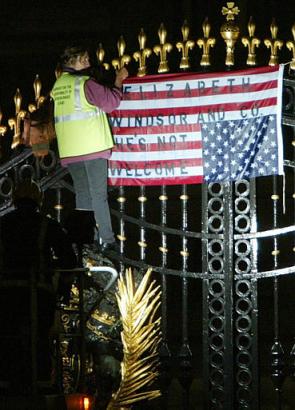
Clarion Events has bought the company DSEi from Reed Elsevier, who seem to have responded to ethical objections to DSEi's area of expertise. DSEi runs regular arms fairs in Britain where states - including some of the most repressive states in the world - can buy weapons and torture equipment from arms dealers. The event is heavily policed and protestors are regularly arrested. This happened to 66-year-old pacifist Gwyn Gwyntopher who was dragged in handcuffs across the concrete of a railway station (although she had a valid ticket) in case her presence and placard cause offence to any arms dealers. She was later acquitted of trespass.
Campaign Against Arms Trade suggests that people might like to write to Simon Kimble, the Chief Executive of Clarion Events expressing their concerns about arms fairs. They provide a helpful form HERE. The address of Clarion Events is Earls Court Exhibition Centre, Warwick Road, London SW5 9TA.
The video shows Mark Thomas considering the arguments in favour of arms sales.
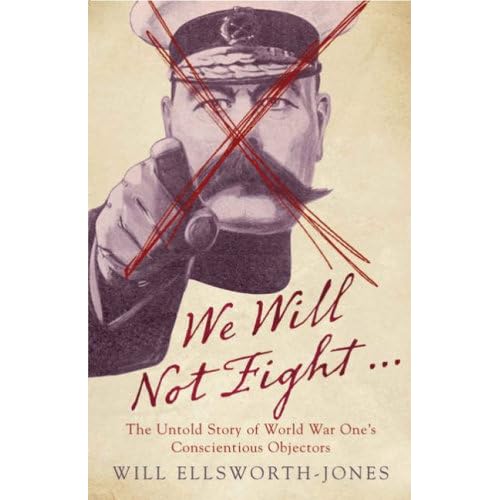
A review in today's Guardian reminded me of the history of pacifist conscientious objection - and how difficult it was. One of the books discussed, We Will Not Fight by Will Ellsworth-Jones, looks at the case of Bert Brocklesby, whose two brothers were at the front. War was against Bert's Christian beliefs (he was a Methodist) but he wasn't granted conscietntious objector status. Instead he was shipped out to France and sentenced to death.
The review, by Francis Beckett, is full of telling quotations and anecdotes about the horrors of the First World War. It wasn't just a time of jingoistic patriotism but also period in which general conscription was first introduced. Most British Christians were war-mongers and the review quotes Archdeacon Basil Wilberforce, chaplain to the Speaker of the House of Commons, preaching that:
"To kill Germans is a divine service in the fullest acceptance of the word." It's hard to stand out against trends in the way that Bert Brocklesby and others did. In the twentieth century, Quaker pacifists probably had an easier time than most because they had the support of their Meetings. There was a whole organisation supporting them. They might be sent to prison but I've heard accounts of Quaker Meetings in prison in wartime. Conscientious objectors acting alone and without the support of their churches - like the Austrian Catholic anti-Nazi Franz Jagerstatter - had a much harder time. Bert Brocklesby, who eventually survived, was neglected and condemned by army chaplains:
"Under sentence of death in Boulogne, in a filthy cell, Brocklesby was visited by a chaplain, who held his nose against the smell. "What is your religion?" asked the chaplain. "I'm a Methodist." "Oh, I'm sorry, I can't help you - I'm Church of England." Worse was the chaplain who visited Brocklesby after his reprieve and called him "a disgrace to humanity"."
It's good to remember how people have suffered for their beliefs in the past and to acknowledge how much we have built on the work of people who stood against attutudes, policies and laws which most people now agree were wrong. But that's not enough. George Fox's question "What canst thou say?" still has force. Perhaps we should also ask ourselves, "What canst thou DO?"
If you feel uneasy about red poppies and would like to wear a white poppy instead, I have some which I ordered from the Peace Pledge Union. I'll try to remember to bring them to Meeting next Sunday, or you can ask me beforehand, if you would like. (Martin also has a couple in case of requests.)
The Peace Pledge Union offers a range of resources which can be ordered through their site. These include a history of conscientious objection in World War I which is recommended by Martin. Apparently First World War conscientious objectors lost the right to vote until 1926. I hadn't known that.
Information and ideas on campaigning from Campaign Against Arms Trade, in which many Quakers and others are involved.
A useful article I found on the BBC website (from an interfaith group in West Wiltshire. This includes a particularly challenging sentence from John Woolman:
“May we look upon our treasures, the furniture of our houses, and our garments, and try whether the seeds of war have nourishment in these our possessions.”
It's a helpful reminder that wearing a white poppy may not be enough.