Showing posts with label George Fox. Show all posts

Sunday, 22 February 2009

The battle of the buses


posted by kathy

The atheist bus campaign has come to an end for now. I've found it rather cheering. Theological debate on buses seems a worthy successor to the wonderful poems on the underground. Since the atheist buses launched, there have been Christian buses (in at least three varieties as well as a brilliant suggestion for a Buddhist bus. I briefly wondered about a Quaker bus and started to think of suitable slogans. But all I could come up with was the famous George Fox quotation urging Quakers to "walk cheerfully over the world, answering that of God in every one." I'm not sure the bus companies would like the bit about walking - it might interfere with their revenues.

I was forced to question my enjoyment of the bus campaigns when I read of the driver who refused to drive a bus with an atheist poster on the side. This wouldn't be the kind of poster that worried me. But for one driver this was a matter of conscience so serious that he was prepared to risk his job.

Are there posters that would cause Quakers similar concern? How about a bus which carried an advertisement urging young people to join the army? Would a Quaker bus driver have problems with that or would the driver decide that it was more important to get passengers to their destinations?

Are there any Quaker bus drivers?


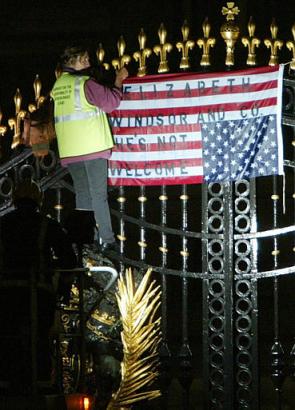
(photo by Jon Worth, British Humanist Association)

Saturday, 17 May 2008

Saying "no" to war


posted by kathy


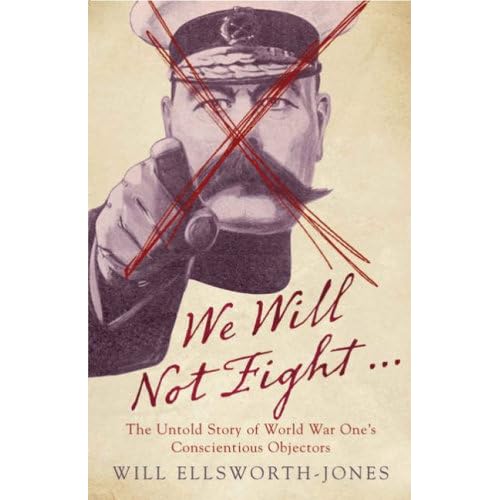
A review in today's Guardian reminded me of the history of pacifist conscientious objection - and how difficult it was. One of the books discussed, We Will Not Fight by Will Ellsworth-Jones, looks at the case of Bert Brocklesby, whose two brothers were at the front. War was against Bert's Christian beliefs (he was a Methodist) but he wasn't granted conscietntious objector status. Instead he was shipped out to France and sentenced to death.

The review, by Francis Beckett, is full of telling quotations and anecdotes about the horrors of the First World War. It wasn't just a time of jingoistic patriotism but also period in which general conscription was first introduced. Most British Christians were war-mongers and the review quotes Archdeacon Basil Wilberforce, chaplain to the Speaker of the House of Commons, preaching that:

"To kill Germans is a divine service in the fullest acceptance of the word."


It's hard to stand out against trends in the way that Bert Brocklesby and others did. In the twentieth century, Quaker pacifists probably had an easier time than most because they had the support of their Meetings. There was a whole organisation supporting them. They might be sent to prison but I've heard accounts of Quaker Meetings in prison in wartime. Conscientious objectors acting alone and without the support of their churches - like the Austrian Catholic anti-Nazi Franz Jagerstatter - had a much harder time. Bert Brocklesby, who eventually survived, was neglected and condemned by army chaplains:

"
Under sentence of death in Boulogne, in a filthy cell, Brocklesby was visited by a chaplain, who held his nose against the smell. "What is your religion?" asked the chaplain. "I'm a Methodist." "Oh, I'm sorry, I can't help you - I'm Church of England." Worse was the chaplain who visited Brocklesby after his reprieve and called him "a disgrace to humanity"."

Today it's pretty well accepted that Quakers are conscientious objectors. But Quakers are also involved, more controversially, in direct action: in the campaign against the U.S. spy base at Menwith Hill, for instance; in protesting against arms fairs and the arms trade; opposing extraordinary rendition, torture and the theft of Diego Garcia from the Chagos Islanders. Meeting for Sufferings (the central administrative committee of the Society of Friends) may be concerned with such bureaucratic tasks and the central framework of the society, but it also considers questions which may be unpopular today - such as the need asylum seekers have for friendship, care and support. And from time to time, Meeting for Sufferings still records the arrest and imprisonment of Friends.

It's good to remember how people have suffered for their beliefs in the past and to acknowledge how much we have built on the work of people who stood against attutudes, policies and laws which most people now agree were wrong. But that's not enough. George Fox's question "What canst thou say?" still has force. Perhaps we should also ask ourselves, "What canst thou DO?"


Note: The Housmans website has a good list of books on Pacifism and Non-Violence.

Tuesday, 5 June 2007

a new blog!

posted by kathy.

This is a blog for Beeston Quakers. It's a new idea and only semi-official, in that no-one said "Don't" when I raised the question after Meeting. For the moment it will be managed by me and Rhiannon. Other volunteers from the Meeting are welcome. So are visitors. If you visit, do feel free to post a comment.

One announcement at Meeting was about the Stop the War protest at the Labour Party's Leadership Conference in Manchester on Sunday 24 June. There are coaches from outside the Salutation Inn, leaving at 9.30 a.m. (£14 waged, £7 unwaged) but you need to book in advance. See the website of Nottingham Stop the War campaign for further details.

But this blog isn't just for external political events. I thought it would be a good idea to include extracts from Quaker and other writings from time to time. As the notice I'm posting is about peace, I thought it would be a good idea to include some early Quaker writings about peace and the peace testimony.

"We…utterly…deny all outward wars and strife and fightings with outward weapons, for any end or under any pretense whatsoever. And this is our testimony to the whole world. … The spirit of Christ, by which we are guided, is not changeable, so as to once command us from a thing as evil and again to move unto it; and we do certainly know, and so testify to the world, that the Spirit of Christ which leads us into all Truth will never move us to fight and war against any man with outward weapons, neither for the kingdom of Christ, nor for any kingdoms of this world."
(George Fox, 1660)


May we look upon our treasures, the furniture of our houses, and our garments, and try whether the seeds of war have nourishment in these our possessions.
(John Woolman, c.1764)


This more recent statement sadly seems relevant today. I don't know if Quakers in 1976 thought such words might one day be applied to the British and United States governments:

"It is a matter of grave anxiety that torture and secret imprisonment are being used by many governments, anti-government groups and others to extract information, to suppress criticism, and to intimidate opposition, so that throughout the world countless numbers of men, women and children are suffering inhuman treatment. We believe in the worth of every individual as a child of God, and that no circumstances whatsoever can justify practices intended to break bodies, minds and spirits.
"Both tortured and torturer are victims of the evil from which no human being is immune. Friends, however, believe that the life and power of God are greater than evil, and in that life and power declare their opposition to all torture. The Society calls on all its members, as well as those of all religious and other organisations, to create a force of public opinion which will oblige those responsible to dismantle everywhere the administrative apparatus which permits or encourages torture, and to observe effectively those international agreements under which its use is strictly forbidden."
(Friends World Committee for Consultation, 1976)


Finally, from the introduction to the Advices and Queries which are sometimes read (just one or two at a time) in Quaker Meetings for Worship:

Our diversity invites us both to speak what we know to be true in our lives and to learn from others. Friends are encouraged to listen to each other in humility and understanding, trusting in the Spirit that goes beyond our human effort and comprehension
.

This seems a good starting point for this blog.