Showing posts with label asylum. Show all posts

Tuesday, 30 December 2014

City of Sanctuary - the Birmingham Declaration

One of the central concerns of Quakers is to look for that of God in everyone. This is, I think, at the heart of some of our testimonies, including those for peace and equality. Quakers naturally differ in their understanding of God but they recognize that there is something they might term "the divine" or "the inner light" in all human beings. This doesn't mean that all human beings act well, since obviously they don't, but that there is something in human beings that we can, at  the very least, try to nurture and address.

It is not surprising that Quakers have, for a long time, been concerned to help asylum seekers, refugees and migrants. Quakerism has its roots in Christianity, a religion which has numerous stories of refugees and migration (as do very many religions). The flight of Mary, Joseph and the baby Jesus is a well-known example. Similarly the disciples of Jesus became migrants. Quakers are now praised for the assistance they gave to refugees in the 1930s but this was not always a popular course of action.

Current hatred and fear of migrants is disturbing. I don't think the majority of the population feel hate and fear towards the individuals they encounter but it's easy to fear the unknown - and the media frequently treat vulnerable migrants as a mass who lack individual human characteristics. 

The City of Sanctuary movement calls for hospitality towards asylum seekers, refugees and  migrants. Recently it has asked groups to put their names to the "Birmingham Declaration." Beeston Quakers are very happy to sign this Declaration. The text can be found below. If you are a member of a group which would like to sign this declaration, it's easy to do so using this link.

City of Sanctuary - Birmingham Declaration

Britain has a long tradition of offering protection to those fleeing persecution, many of whom have gone on to make a considerable contribution to our society. It also has a reputation for fairness and justice that is the envy of many other nations.

We believe that the great majority of British people are sympathetic towards those who come here seeking help and protection.

We have come together in Birmingham on 15th November 2014 in recognition that the position of refugees and migrants is aggravated in Europe and in Britain in an unprecedented way. We can no longer just watch in silence as millions flee Syria only to be warehoused in refugee camps and thousands drown in desperate attempts to reach the Western world across the sea. This is a matter of life and death.

We commit ourselves to work together to ensure that our great country continues to be a safe place for those fleeing persecution and a welcoming place for all people who come here to study, work or join family and who will work alongside us to build a just and fair society.

We commit ourselves today to a core set of principles and asks that will strengthen our collective efforts to protect the rights of strangers amongst us. Through these commitments we seek accountability and justice. We are asking our Parliament and our Government to take necessary steps to deliver that change.

These commitments tackle the causes and consequences of the very vulnerable position refugees and migrants find themselves in. They are within the scope of the international protection framework that Britain has been signatory to for decades.

Recognising that we all have a role to play, we are asking our Government to do all they can to ensure that:

1. All asylum seekers, refugees and migrants should be treated with dignity and respect.
We ask that the debate on immigration is conducted with care for the dignity of people who are vulnerable, who do not have a voice in the public domain and who have to suffer the consequences of inaccurate and inflammatory language. We appeal to all politicians and to the media to conduct the pre-election debate responsibly, sticking to the facts and bearing these principles in mind.

2. A fair and effective process to decide whether people need protection should be in place.
We ask for a high standard of decision making on refugee protection cases. After years of very public failure, we demand a system that is fair and efficient and ensures protection for those who need it. People should have access to good quality legal advice and representation during the process, publicly funded when they are unable to pay. Not everyone is entitled to refugee status in Britain, but they are entitled to a fair process to determine if they are in need of protection.

3. No one should be locked up indefinitely.
We seek an end to the indefinite detention of asylum seekers and migrants. No one should be deprived of their liberty with no judicial oversight. Indefinite detention is unacceptable, costly and ineffective. We ask for a reasonable time limit to be introduced and other safeguards put in place to ensure the lawfulness and fairness within the system.

4. No one should be left sick or destitute in our society.
It cannot be right that people are left destitute in modern Britain, banned from working but denied support. Until they are granted protection and can work, asylum seekers should receive sufficient support to meet their essential living needs while in the UK. We are asking that those whose cases have taken more than six months to resolve, or who have been refused but are unable to return home, should receive permission to work. All of them should be allowed free access to NHS services

5. We should welcome the stranger and help them to integrate.
People should integrate, and we should help them to do so. We are asking for support for asylum seekers to be welcomed and befriended on arrival. To help them integrate and participate in the local community they should be able to learn English, with free tuition provided where needed.
We make a commitment to take action on these principles and asks together and translate them into collaborative actions in our organisations and communities locally and nationally in the run up to the next general elections and beyond.

We commit ourselves to work strategically together. We will come back next year to check our progress against these principles and asks and make plans for what needs to be done in the future, together. Below are the first of what we believe will be hundreds of organisations signing this declaration.
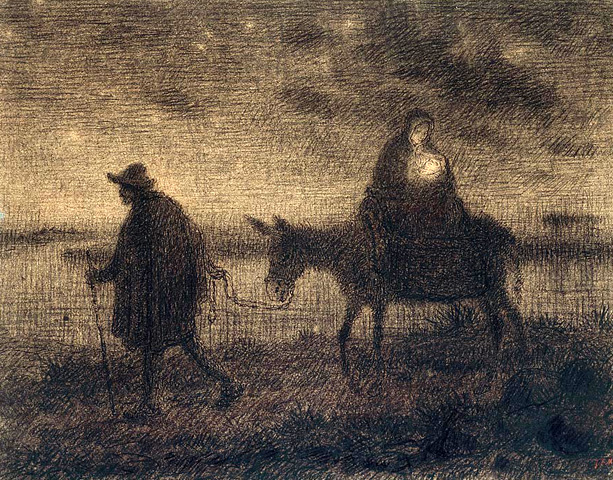
 
(Flight into Egypt by Millais)

Tuesday, 16 June 2009

Refugee Week

posted by kathy


It's Refugee Week again and I'm late in posting links and details.

The Refugee Week website gives plenty of information with details of events nationwide. There's a special Simple Acts campaign this year
. We're asked to do just one simple thing to change the way in which refugees are perceived in Britain. You might cook a meal from a different country, tell or read a story about refugees, get to know local asylum-seekers or join a campaign.

As my contribution, I'm going to mention three familiar stories about people in exile who rely on the kindness and hospitality of others.


My first choice is the story of Odysseus. When the Trojan war is over, he spends years trying to get home. The Odyssey praises the people who show kindness to strangers and treat them generously as guests. The picture shows the princess Nausicaa, who finds Odysseus exhausted and naked on the shore. She invites him to the palace for food, drink and rest.


My second choice of story is Sleeping Beauty. Beauty is an exile in fear of her life, who receives hospitality in exchange for housework.


My final
selection is the story of Jesus, Mary and Joseph, fleeing persecution by leaving home and spending a time in Egypt - a country with different customs, religion and language.


All these stories agree that hospitality to those in need is important. Kindness to vulnerable and needy strangers is a theme of many old stories. They often suggest that such hospitality is a sign of a good society.


There are plenty of events near Beeston - you will find details below. Jonathan asked me to draw attention to the City of Sanctuary meeting (tomorrow!) and the whole City of Sanctuary movement.


TUESDAY 16TH JUNE
Learn how to DJ workshops (FREE)
… and make tunes using technology and cutting edge software. All levels welcome
Venue: SEND Project Studio, Greenway Centre, Trent Lane, Sneinton NG2 4DF Time: 3-6pm (8-14 yrs olds); 7-10pm (14-19 yrs olds) Email: beats@sendproject.com

Capoeira Angola Special Beginners Dance Sessions (FREE)
Venue: New Art Exchange, Hyson Green Time: 7:30 - 9:30pm Contact: Just turn up. (Wear comfortable clothing and light shoes)

Taxi to the Dark Side
US 2007. Dir Alex Gibney. 106min. Certificate 15
This Oscar-winning film is a gripping investigation into the use of torture by the US military as part of its ‘war on terror’. A documentary murder mystery, the film examines the death of an Afghan taxi driver at Bagram Air Base, exposing a worldwide policy of detention that condones torture and ignores human rights.
Venue: Broadway, Broad Street, Hockley NG1 3AL

Quiz Night – Who wants to be a Zimbabwean Billionaire?
Pub Quiz on the Citizen Test
Organised by Nottingham Zimbabwean Community Network
Venue: Lincolnshire Poacher, 161 Mansfield Road NG1 3FR Time: 7.30pm


WEDNESDAY 17TH JUNE
City of Sanctuary Open Day (FREE)
Speaker: Craig Barnett (The National Organiser) What is the City of Sanctuary movement?
Hear the stories of people seeking sanctuary in Nottingham. How can we, as the host community, help? Get involved as a City of Sanctuary volunteer. Vegetarian food provided
Venue: St Stephens Church, Bobbers Mill Road, Hyson Green Time: 11am – 1pm

Jupiter's Dance (FREE FILM)
Producers: Renaud Barret and Florent de La Tullaye DONATION FOR FOOD
A documentary film set in the ghettos of Kinshasa in the 1970s where street children, beggars, prostitutes and disabled victims of polio, strive to find their daily bread in an urban jungle that has plummeted into poverty and violence. The film shows how music is allowing these disenfranchised Congolese to stand up and be counted. Jupiter’s Dance should be obligatory viewing for all lovers of African music, as well as those who want to admire the defiance of the human spirit in this beleaguered nation.
Venue: SUMAC Centre, 245 Gladstone Street, Forest Fields Time: 7pm vegan food – 7.45pm film
Tickets: Admission free – donation for food. All proceeds to NNRF Tuesday Project For more information: www.smallworldcinema.wordpress.com


La Forteresse (The Fortress) - UK premiere
Switzerland 2008. Dir Fernand Melgar. 104min.
For the first time, a camera looks into the hidden world of a Swiss reception centre for asylum seekers. Awarding it the Golden Leopard, the Locarno festival jury cited ‘a remarkably sensitive film exhibiting profound human intelligence.’ www.laforteresse.ch
Venue: Broadway, Broad Street, Hockley NG1 3AL Time: 8.15pm


THURSDAY 18TH JUNE

Refugee Rights FREE
What are they? How are they under attack? How can they be protected?
Speakers:
Alice Edwards, Lecturer in Refugee & Human Rights Laws, University of Nottingham
Vincent Fox, Solicitor, First Call Immigration Services, Nottingham
Venue: Refugee Forum, The Square Centre, Alfred Street North NG3 1AA Time: 7.30pm followed by Q&A


FRIDAY 19TH JUNE
Rainbow Project Fundraising Dinner
Delicious African and Asian Food served with Caribbean Punch. All funds to support people seeking Asylum and Refuge
Venue: The Vine Community Centre, Bobbers Mill Road, Hyson Green Time: Arrive at 7pm – Eat at 7.30pm
Tickets: £10 / Asylum seekers & refugees free / unwaged & senior citizens (donate if able) Contact: dskerritt@southwell.anglican.org

Cabaret Sorbet
Cabaret Sorbet is an audio-visual live performance night incorporating an eclectic mix of music, dance, illustration, sculpture, spoken word, body art, film projections, and theatre. This month’s event has contributions from international artists / artists in exile.
Venue: The Art Organisation, Station Street Time: 8pm – 12 midnight Ticket: £2 / £3 on the door (bring your own booze)
Contact: Via myspace or facebook by typing Cabaret Sorbet, or email: cabaret-sorbet@live.co.uk


SATURDAY 20TH JUNE
Family Fun Day

An afternoon of puppet-making, storytelling, dance and art workshops for all the family. FREE and open to all.
Venue: 1st Floor, Central Library, Angel Row Time: 12.30 – 3.30pm Contact: Juliet / juliet.line@nottinghamcity.gov.uk

Wednesday, 18 June 2008

One Man's Journey

posted by Rhiannon

I wanted to follow up Kathy's excellent post with a personal and specific account of one of the local events. I'm not going to make it to any of the evening things, but popping in the Central Library for an hour was easy and really informative.

The exhibition (Nottingham Central Library, Angel Row, June 1st-30th 2008) is called "One Man's Journey Through the Asylum Process", and has been created by the Sankofa Foundation. It displays, though photographs, objects, a video, and background documents, what happened to one man who left Kurdistan Iraq in 1998. Although the Immigration Tribunal didn't doubt that he had indeed been in danger, but believed that he could relocate to somewhere else in Iraq.

For all that there are important differences between refugees and asylum seekers (see the comments to Kathy's post), they also tend to have similar needs when they arrive here: food, shelter, support, English lessons, and so forth. A couple of years ago, I was trained as an In4mer (peer educator) through GirlguidingUK, and one of the topics I teach in that capacity is 'Refugees and Asylum Seekers'. In those sessions, I often find that the participants (typically 7-14 year old girls, who repeat the things their parents say) believe many mistaken things. For example, they often think that asylum seekers can be illegal (not true: everyone has a right to seek asylum, though many will not be granted it).

Very few of them have taken the time to think about what it must be like to be in that situation: so as well as explaining, we do exercises with them to prompt thought. We start playing a game but only give the rules in Spanish--to parallel the way that asylum seekers, including the One Man of the exhibition, need help to understand what is going on. We ask them to rate food, water, family, shelter, education, and other things in order of importance--to bring to their attention how much they may have lost.

Even fewer if any of them, though, are mature enough to begin to think about other themes of this exhibition: the loneliness of being cut off from your family and unable to participate normally in British society, the mixed longing to go home and fear of what will happen if you do, and the struggles with the legal system here.

When his application was rejected, this man ended up living in the corner of the factory where he worked--not for pay, but for the right to sleep in the corner. Later he lived in his allotment shed. He is now back in Kurdistan, but (despite all that has happened in Iraq), the Kurds are still, to quote the exhibition signs, "a nation without a state" and his family are "trying to live a very low-profile existence in the shadows".

I found it especially moving that he had left behind so many photographs (having treasured images of his family during their decade apart) which let us have an insight into his experience.

Saturday, 17 May 2008

Saying "no" to war


posted by kathy


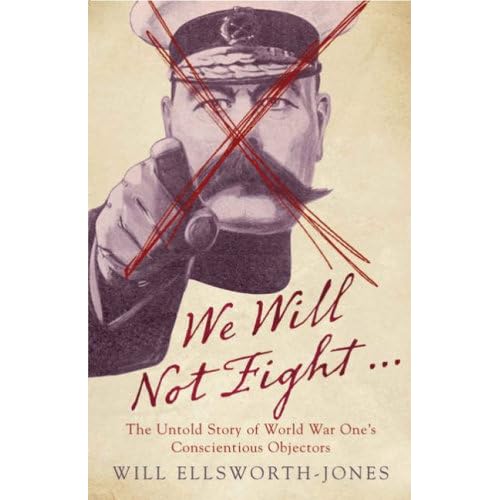
A review in today's Guardian reminded me of the history of pacifist conscientious objection - and how difficult it was. One of the books discussed, We Will Not Fight by Will Ellsworth-Jones, looks at the case of Bert Brocklesby, whose two brothers were at the front. War was against Bert's Christian beliefs (he was a Methodist) but he wasn't granted conscietntious objector status. Instead he was shipped out to France and sentenced to death.

The review, by Francis Beckett, is full of telling quotations and anecdotes about the horrors of the First World War. It wasn't just a time of jingoistic patriotism but also period in which general conscription was first introduced. Most British Christians were war-mongers and the review quotes Archdeacon Basil Wilberforce, chaplain to the Speaker of the House of Commons, preaching that:

"To kill Germans is a divine service in the fullest acceptance of the word."


It's hard to stand out against trends in the way that Bert Brocklesby and others did. In the twentieth century, Quaker pacifists probably had an easier time than most because they had the support of their Meetings. There was a whole organisation supporting them. They might be sent to prison but I've heard accounts of Quaker Meetings in prison in wartime. Conscientious objectors acting alone and without the support of their churches - like the Austrian Catholic anti-Nazi Franz Jagerstatter - had a much harder time. Bert Brocklesby, who eventually survived, was neglected and condemned by army chaplains:

"
Under sentence of death in Boulogne, in a filthy cell, Brocklesby was visited by a chaplain, who held his nose against the smell. "What is your religion?" asked the chaplain. "I'm a Methodist." "Oh, I'm sorry, I can't help you - I'm Church of England." Worse was the chaplain who visited Brocklesby after his reprieve and called him "a disgrace to humanity"."

Today it's pretty well accepted that Quakers are conscientious objectors. But Quakers are also involved, more controversially, in direct action: in the campaign against the U.S. spy base at Menwith Hill, for instance; in protesting against arms fairs and the arms trade; opposing extraordinary rendition, torture and the theft of Diego Garcia from the Chagos Islanders. Meeting for Sufferings (the central administrative committee of the Society of Friends) may be concerned with such bureaucratic tasks and the central framework of the society, but it also considers questions which may be unpopular today - such as the need asylum seekers have for friendship, care and support. And from time to time, Meeting for Sufferings still records the arrest and imprisonment of Friends.

It's good to remember how people have suffered for their beliefs in the past and to acknowledge how much we have built on the work of people who stood against attutudes, policies and laws which most people now agree were wrong. But that's not enough. George Fox's question "What canst thou say?" still has force. Perhaps we should also ask ourselves, "What canst thou DO?"


Note: The Housmans website has a good list of books on Pacifism and Non-Violence.

Thursday, 22 November 2007

Against torture

In 2005, American Quakers reported on a massacre at Andijan in Uzbekistan. Nobody knows how many protesters were killed by government forces, but eyewitness accounts tell of of a square awash with blood. No-one can be sure how many men, women and children were killed.

Uzbekistan has a government which doesn't hesitate to kill its citizens. The opposition party is banned. Torture is common. Many critics of the regime have been killed.

It's hard to understand how the British government and courts can authorise the deportation of an Uzbek asylum-seeker. Jahongir Sidikov, who belongs to Erk, Uzbekistan's banned opposition party, faces deportation. He's currently in a cell at Heathrow after passive resistance saved him from being deported yesterday. He's now threatened with forcible removal - to Uzbekistan, where political prisoners are routinely tortured.

If you wish to act in support of Jahongir, even if it's only by sending an e-mail to your MP, these details will be useful:

Home Office ref. – S2185191
Port ref. – BGT/188094
DMS ref. – 67823

Jahongir is currently in Harmondsworth Detention Centre. (possibly now held at Heathrow)

Jahongir's deportation is, beyond any possible dispute, illegal under international law. The UK is a State Party to the UN Convention Against Torture, which states at Article 3:

Article 3 1. No State Party shall expel, return ("refouler") or extradite a person to another State where there are substantial grounds for believing that he would be in danger of being subjected to torture.

2. For the purpose of determining whether there are such grounds, the competent authorities shall take into account all relevant considerations including, where applicable, the existence in the State concerned of a consistent pattern of gross, flagrant or mass violations of human rights.

31 years ago, Friends World Committee for Consultation wrote the following minute:

It is a matter of grave anxiety that torture and secret imprisonment are being used by many governments, anti-government groups and others to extract information, to suppress criticism, and to intimidate opposition, so that throughout the world countless numbers of men, women and children are suffering inhuman treatment. We believe in the worth of every individual as a child of God, and that no circumstances whatsoever can justify practices intended to break bodies, minds and spirits.

Both tortured and torturer are victims of the evil from which no human being is immune. Friends, however, believe that the life and power of God are greater than evil, and in that life and power declare their opposition to all torture. The Society calls on all its members, as well as those of all religious and other organisations, to create a force of public opinion which will oblige those responsible to dismantle everywhere the administrative apparatus which permits or encourages torture, and to observe effectively those international agreements under which its use is strictly forbidden.

Friends World Committee for Consultation, 1976

[Quaker Faith and Practice 23.31]

If our government deports Jahongir Sidikov to Uzbekistan,his life will be at risk. I think that we, as Quakers, should join the campaign to halt his deportation.