Showing posts with label Quakers. Show all posts

Friday, 3 August 2012

The August break

The Memorial Hall is becoming a familiar place for Beeston Quakers.  We have seen new visitors in the past few months and were particularly pleased to welcome a baby last Sunday.   We have grown accustomed to the hall and the kitchen and adjacent rooms. 

However we remain a small Meeting and depend of a core of a few members and attenders.  We have therefore decided that we shall not hold Meeting for Worship in Beeston during August 2012.

There are Quaker Meetings in Nottingham, Derby and Loughborough which should welcome visitors (though it may be necessary to find out about facilities and Meeting for children in advance).  

Meeting in Beeston in the Chilwell Memorial Hall resumes at 10.30 on Sunday, 2nd September and will welcome visitors.


Saturday, 22 October 2011

Beeston Quakers have moved


posted by Kathy

Beeston Quakers will be meeting in Chilwell Memorial Hall for the next month - and possibly for a long time to come. The hall seems to meet all our needs so we're trying it out, starting on Sunday 23rd October at 10.30 a.m. As always, visitors are welcome. Meeting for Worship lasts an hour and is mostly (sometimes entirely) silent. It is followed by notices after which we usually share hot drinks, biscuits and friendly conversation.

The memorial hall is at 129, High Road, Chilwell (near the turnings off to Cator Lane and Meadow Lane). You can find a map HERE.

Some people may find it strange that Quakers meet in a hall commemorating soldiers who died in the First World War but I think it right to remember all those who died in war. John Woolman, the 18th-century Quaker who refused to pay taxes for war, offers a more pertinent challenge. In his essay "A Plea for the Poor" he calls on Quakers to look at their own possessions and "try whether the seeds of war have any nourishment in them."

I think Beeston Quakers will also feel content that the original principles laid down by the trustees of the memorial hall included these:

“That the Institute shall be used as a club or place of assembly for the inhabitants of Chilwell and the neighbourhood and that in determining what persons or class of persons shall be entitled to use the Institute no regard shall be had to or distinction made on grounds of religious discrimination, political opinions or sex.”

I reckon that chimes well with Quakers' testimony to equality.


Wednesday, 7 September 2011

Wandering Friends

We've been very happy meeting in the Middle Street Resource Centre for nearly twenty years. However new arrangements by the council mean that we are currently homeless, at rather short notice.

On Sunday 11th September we shall hold Meeting for Worship at 10.30 at the new Fire Station in Hassocks Lane, NG9 2GQ. Hassocks Lane is a turning off Queens Road East (the A6005) quite close to Highfields (the University Park).


View Larger Map

If you click on the map you should be able to zoom in and find the street.

All attending will be very welcome.

In the meantime, we need suggestions for the long-term.

Our primary requirements are: a comfortable, fairly quiet room where 15-20 people can meet, ideally sitting in a circle or similar arrangement with books on the centre table. It needs to be available between 10 and 12.30 on Sunday mornings every week.

We would very much like to be able to make and offer hot and cold drinks for attenders after meeting so access to a kettle would help.

Sometimes people bring children to Meeting and it would help to have a small, comfortable room for children to engage in activities with adult care/supervision. The age of the children could vary but it would be unusual for more than four to attend in a single week.

It's important that the venue has access for people with disabilities.

Ideally we would like to be able to leave a large box at the venue between Meetings. This contains mugs, equipment for hot drinks, a tin a biscuits, a first aid kit and a few books and leaflets.

We would like to be able to display a sign while meeting (perhaps in a window) so that people can see where we are. It would be good (but not essential) if we could have a poster up at other times.

If you know of any venue in the Beeston/Chilwell area that might suit us, please post a comment or email beestonquakers@yahoo.co.uk It would help to know how much any venue is likely to charge.

Meanwhile, for updates on our search for somewhere to meet, and details of arrangements on a weekly basis, please watch this blog.

Sunday, 25 April 2010

Votes and testimonies

posted by kathy

Sometimes life gets in the way of things we plan to do. I've been busy with work and Rhiannon with her studies. There were things to say, but we didn't say them on this blog. .

There were plenty of conversations in between, especially after Meeting. Lately we've been discussing the general election. We're not unanimous and many of us are undecided. One of today's attenders summed up the question as whether to vote strategically or vote your conscience. I suspect that's a dilemma many voters face.

There's no one party particularly favoured by Quakers. I've known Quakers in all three mainstream English parties as well as a number of fringe parties. Most aren't members of political parties at all but they usually vote, take a strong interest in politics and may support causes where they think they can make a difference.

Quakers don't have a creed or a body of shared beliefs. We do have what we call "testimonies," which are perhaps best explained as areas of concern. We consider these important when making choices and decisions in our own life. They are also important in our relationship as a body to public life and are therefore bound to influence the way we vote and talk to people in positions of power.

There are different interpretations and descriptions of the testimonies but most Quakers in Britain agree on four core testimonies: truth, equality, simplicity and peace. We agreed today to ask the six candidates for Broxtowe to say where they stand on these testimonies and to post their responses as comments to this blog. Tony, a member of our Meeting, has agreed to draw the attention of all the candidates to this blog.

Because the testimonies are broad, it seems sensible to explain how they have currently been interpreted and prompted action among friends.

People are most likely to encounter the Quaker truth testimony in court. Quakers don't swear oaths - they hold that they are required to speak truth all the time and oath-taking implies more than one standard of truth. In the last twenty years, Quakers have been concerned with the question of integrity in public life, including the pressure on public servants to be dishonest in various ways. Last year, when British Quakers finally decided, after 22 years of consideration, to hold same-sex marriages in Meetings just as we hold opposite-sex weddings, the truth testimony was at least as important as the testimony to equality. Those present - about 1700 Quakers - were reminded of George Fox's words on marriage: "This is the Lord's work and we are but witnesses." We saw that our duty was to witness to what we already saw as marriages.

The Quaker testimony on equality is rooted in the belief that there is that of God in everyone. Sometimes this is described as "the Light within." Quakers are as fallible in acting on this testimony as on any other. However the idea that we should see value in all humans has led us to oppose discrimination and cruelty prompted by such differences as race, gender, sexuality and disability. It has also led us to care for justice between individuals, groups and nations. Quakers are involved with prisoners and asylum seekers and have recently been involved in the Circles of Trust scheme, working with dangerous offenders after their release from prison. You may find it helpful to know that many Quakers refuse to use titles and address all people directly by their names.

The Quaker testimony on simplicity seems particularly apt in a time when there are concerns about the depletion of natural resources and damage to the environment. Historically it has also been linked to the testimony to equality with past Quakers, including William Penn and John Woolman, urging Quakers to avoid the acquisition of wealth for its own sake or for the sake of ostentatious display, especially in the face of poverty. Many Quakers are very concerned for the environment and sometimes care for the environment is listed as a separate testimony.

The Quakers' peace testimony is probably the best known. Almost all Quakers are pacifists. This isn't just a matter of refusing to support or fight in wars. Quakers look for what they term the "seeds of war" in their own lives, in society, in political structures and public actions. Quakers are involved in opposing war through a range of activities and organisations. These include work against military recruitment in schools, opposing the recruitment of child soldiers in Britain and overseas; campaigning against nuclear weapons and the arms trade and also working in schemes which offer training in conflict resolution to children and adults.

It's not possible to offer a summary of all Quaker concerns but I hope this post helps readers to consider some of their own priorities. I also that all the candidates will reply and explain where they stand in relation to the broad points raised by the testimonies. This will help Beeston Quakers and other readers of this blog to decide how best to cast their votes.


I am posting responses as comments, as they arrive. Click on "comments" below to read them.

Monday, 30 June 2008

Why Quaker schools?


posted by kathy


This is a question that has been troubling me for years. Why do Quakers, who have a testimony to equality, run fee-paying schools?

I can see why it started. Education hasn't always been free in England and schools often promoted activities and interests that were directly opposed to Quakerism. There is much that I oppose in school education today. But I would not send my children to a private school because that goes against my Quaker beliefs in equality.

I know that Quaker schools have a good reputation. I can see why people would be reluctant to close something that is good - and I can see a case for schools that stand out against dominant beliefs. But I don't believe Quaker schools, however good their education, are sufficiently free from external pressures to justify their existence as Quaker bodies. The sites talk about Meeting for Worship and internationalism but also about exam success - and there's an implicit message that, by buying a Quaker education for a child, the parents will also be buying the kind of facilities and attention that are not available in the state system.

Private education teaches children that they are special - it implies that they are better than children educated in the state system. I've heard children heading for private education at 11 imply that their schooling confer privilege because they are cleverer and/or better-loved than other, state-educated children. This is dangerous - and may be particularly dangerous when combined with the Quaker approach which values personal insight and individual access to truth. Quaker pupils may be told about equality but what they experience is different. They learn that their insights are valued more than the insights of most children. The stories that Osama bin Laden was educated at the Brummana Quaker school in Lebanon may derive from a confusion of bin Laden brothers, but it seems feasible that children educated at expensive Quaker schools may grow up with an enhanced sense of privilege and a strong belief in the importance of their views.

I have known good people who valued their Quaker education and I know many Quakers are convinced of the value of Quaker schools. But when I consider Quaker schools in the light of Quaker testimonies, it's as though there's a great wall between the testimony to equality and the practice of Quaker schools. I could never teach in a Quaker school and my children attended the local imperfect - but much more inclusive - state schools, although I believe there are scholarships to help the children of Quakers attend Quaker schools.

Quakers have often had difficulty with the testimony to equality. Historically Quakers helped educate the poor and slaves but they usually maintained a line between pauper children, slaves and their own, more privileged Quaker children. Real equality would go further.

The testimony to equality is most severely tested when it comes to our own children. We wonder at their beauty from the moment they are born and yearn for their safety and success. Surely all parents do this. But however much I love my children - and that's a great deal - I cannot live the testimony to equality by saying that my children matter more than yours.

I want to know what other Quakers think - and how non-Quakers view the question. What can you say?


Sunday, 16 March 2008

Rallying for peace


posted by kathy

I didn't see any other Quakers at yesterday's anti-war demonstration. I travelled on my own, by train, and by the time I arrived in Trafalgar Square the main space was full. I saw a number of peaceful protestors - some enthusiastic, some tired - and a few police.

Police said there were 10,000 people there. The organisers said there were 40,000. I don't know if I was included in their figures. All I know is that Trafalgar Square was full and that some groups were assempling in the adjoining streets. There was room to move on the edges of the square, but not much. I couldn't get a good photo showing everyone there.

I stayed for part of the rally but was tired and my foot hurt (I'm supposed to be resting it). I didn't march to Parliament Square though I'd have liked to get there. I hope the sight of protestors cheered Brian Haw.

I took a few photos at the edge of the crowd and watched the march set off. The persistence of marchers, when government seems entirely unconcerned with both public opinion and the suffering in the Middle East, was encouraging.

I also heard a speaker mention the choice Iraqi asylum seekers are being given between deportation and destitution. The government says that Iraq is safe. But then, the Ministry of Defence seems to be rewriting the history of the past five years and circulating it as lesson plans to schools.

The Quaker testimony to Truth is still needed.


Thursday, 31 January 2008

Saving lives and making a difference

posted by Kathy

Sometimes it doesn't seem possible to make a difference. However, last weekend I read on Craig Murray's blog that Jahongir Sidikov, the young Uzbek dissident who was nearly deported, had been granted asylum by the Home Office. This reversal, which may have saved his life, was probably helped by all the letter-writing and blogging on Jahongir's behalf. Somtimes it is possible to make a difference.

Today the Independent is asking readers to sign a petition on behalf of Sayed Pervez Kambaksh, a student who has been sentenced to death by the Afghan courts for reading and circulating and internet report in Farsi which suggested argued that the oppression of women was based on a misrepresentation of the teachings of the prophet Mohammed. The death sentence on Sayed Pervez Kambkash, who is 23 years old, was confirmed yesterday by a motion in the Afghan senate.

I don't know any more details than are given here in the Independent. It seems strange from a Quaker perspective to sentence a young man to death just because he tries to provoke a debate. Quakers have a long history of opposing the death penalty. Quakers have also, in the past, suffered for questioning mainstream religious views, political norms and social customs. (They seem to have gone much further than this young man in disrupting and questioning accepted views.) Quakers have a history of dialogue with Muslims, which has been marked by courtesy, if not always by mutual understanding.

You can sign the petition HERE.

Saturday, 10 November 2007

Events for 11th November 2007

posted by Kathy (with apologies for late posting)

I meant to pass on details of a couple of Nottingham events but left it extremely late.

However,

Coinciding with Meeting for Worship, Nottingham Stop the War campaign is organising a protest outside the army recruitment centre at the side entrance to the Victoria Centre. Like Meeting, this begins at 10.30 a.m.


In the afternoon, John Hort of Nottingham CND is introducing a screening of the film, The Last Atomic Bomb at the Broadway Cinema in Nottingham. This starts at 3.00 p.m. Tickets bought from Nottingham CND rather than the Broadway cost £2 each (plus donation towards CND's costs if you wish). Ask me if you want details of how to purchase from CND. I assume that the Broadway will charge their usual amount for tickets bought from the Broadway Box Office.

Nottingham CND has provided the following details of the film:

"
Directed by Robert Richter, the film tells the story of 10-year-old Sakoe Shimohira, hiding in a shelter in Nagasaki near ground zero when the bomb fell, and the aftermath of that day. Her experiences are interwoven with documentary material about - among others - the US decision to use the bomb, censorship of its effects in the US and Japan, the build up of nuclear weapons during the Cold War, and today’s nuclear proliferation."

You can also read the New York Times review of The Last Atomic Bomb by clicking here.


Sunday, 28 October 2007

White poppies


posted by kathy

If you feel uneasy about red poppies and would like to wear a white poppy instead, I have some which I ordered from the Peace Pledge Union. I'll try to remember to bring them to Meeting next Sunday, or you can ask me beforehand, if you would like. (Martin also has a couple in case of requests.)

The Peace Pledge Union offers a range of resources which can be ordered through their site. These include a history of conscientious objection in World War I which is recommended by Martin. Apparently First World War conscientious objectors lost the right to vote until 1926. I hadn't known that.

Here are a couple of useful on-line links:

The chapter on peace in Quaker Faith and Practice.

Quaker activities at Faslane.

Details of the Quaker-supported Campaign for the Accountability of American Bases at Menwith Hill.

Information and ideas on campaigning from Campaign Against Arms Trade, in which many Quakers and others are involved.

A useful article I found on the BBC website (from an interfaith group in West Wiltshire. This includes a particularly challenging sentence from John Woolman:

“May we look upon our treasures, the furniture of our houses, and our garments, and try whether the seeds of war have nourishment in these our possessions.”

It's a helpful reminder that wearing a white poppy may not be enough.

Monday, 24 September 2007

Open to new light?

posted by Kathy

"
Are you open to new light, from whatever source it may come?"

That's one of the challenges posed by Advices and Queries. One of the blogs I read from time to time is Adventus, an American blog which I think comes from an Episcopalian (C of E) perspective. Sometimes I find it "speaks to my condition".

Today it includes an extract from an interview with President Ahmadeinejad of Iran, broadcast on United States television. Being told that President Bush is "without question, a very religious man", President Ahmedeinijad began to question this. This led him to explore what religion means:

"What religion, please tell me, tells you as a follower of that religion to occupy another country and kill its people? Please tell me. Does Christianity tell its followers to do that? Judaism, for that matter? Islam, for that matter? What prophet tells you to send 160,000 troops to another country, kill men, women, and children? You just can't wear your religion on your sleeve or just go to church. You should be truthfully religious. Religion tells us all that you should respect the property, the life of different people. Respect human rights. Love your fellow man. And once you hear that a person has been killed, you should be saddened. You shouldn't sit in a room, a dark room, and hatch plots. And because of your plots, many thousands of people are killed. Having said that, we respect the American people. And because of our respect for the American people, we respectfully talk with President Bush. We have a respectful tone. But having said that, I don't think that that is a good definition of religion. Religion is love for your fellow man, brotherhood, telling the truth.
"

While I am not in sympathy with all the President Ahmedeinijad's statements, his words on this occasion deserve consideration. I'm glad to have read this - and Adventus's post on the subject.

Meanwhile, Nigel recommends this article from today's Guardian about Quaker Meeting and silence. And I can't remember who recommended reading this piece in which the previous Guardian religious affairs correspondent gives the reason for his resignation.

And I've just followed a link to a page of Quaker information, ideas, diaries and resources, including the chance to win a Quaker T-shirt! Is this a Quaker first?

Saturday, 22 September 2007

Quakers in the Guardian

posted by Kathy

You may be interested in a comment piece by David Boulton in the Guardian newspaper. It's written for the beginning of National Quaker Week. As it's in the "comment is free" section, it's possible to post on-line comments on the article.

Saturday, 15 September 2007

An introduction to Quakers

posted by kathy

For anyone who would prefer it, you can watch the first of the Introduction to Quakers videos that Rhiannon mentioned by clicking on the picture below. there are further videos nearby on youtube, incuding some on Quaker testimonies.


On this video, members of Watford Quaker Meeting are talking about the Quaker testimonies. These lead into a discussion of Quakers and political activism:


You can find these and other videos in the series here. Do feel free to post comments or pass the videos to others, if you find them helpful.

Wednesday, 29 August 2007

A message from Jonathan to Beeston Quakers

posted by Kathy for Jonathan

Quaker Quest gets underway at Nottingham FMH on Weds Sept 26th. Before then, we want to circulate as many homes as possible with a leaflet drawing people's attention to these meetings. From the day after the Saturday training day (Sept 8), we hope that as many Friends as possible will drop leaflets through letter boxes.

Can Beeston Quakers help in this task? I have packs of about 30 each which I would be glad to deliver to anyone who do some distributing. I would need to make a note of streets you cover to avoid duplication.

We are well aware that only a tiny fraction will result in an attender at Quaker Quest, but it will mean that more people become aware that Quakers still exist.

In friendship,

Jonathan


If you want to help, you can mention it at Meeting on Sunday or e-mail Kathy if you don't know how to contact Jonathan directly. Or you can post a comment.

Back to Meeting

posted by Kathy
I don't expect Meeting on Sunday will look anything like this. We wouldn't know what to do with all the people and the costumes might excite attention. Besides, with shared Eldership, we would have problems with an Elders' Bench.

However, it will be good to get back to Meeting on Sunday. Yes, it's September on Saturday. That means we're back to weekly Meetings for Worship (at the Day Centre in Middle Street at 10.30 a.m.).

Meanwhile, here's a peaceful photo that I took on my holiday. Other peaceful holiday pictures would be welcome additions to the blog - as would thoughts and reflections from the summer. I hope you've all had a good summer and look forward to seeing you again.

Please remember Rhiannon's request that we consider what we'd like to do for National Quaker Week. It doesn't have to be anything very big or time-consuming but if you would like to wear a badge or put up a poster, for instance, it might be as well to get the badge or poster in advance.


Friday, 27 July 2007

Butlin's for Quakers

posted by kathy

I've just realised that Summer Gathering is a sort of Quaker Butlin's. Not the new Butlin's, where people do their own thing, but the old-style Butlin's, complete with organised activities, plenty for children and a full-time entertainments team. Summer Gathering has its own redcoats, though there are differences. For a start, they don't wear red coats but blue scarves - unless they're working with the children, in which case the scarves are orange. Quite often the Summer Gathering entertainments team will suggest a period of silence. So far as I know, Butlin's never provided that. Butlin's redcoats are employees. Ours, known as the "core team", are hard-working volunteers.

There aren't quite wall-to-wall entertainments and activities but sometimes it feels like that, especially when there's a hilly campus to cross. The marquee hosts events which range from Meeting for Worship to the end of Gathering ceilidh. There's community singing, talks and an evening when Quaker groups can lay out their wares and talk about their activities.


We also have small base groups, although I've mostly given mine a miss. I got into the swing of Summer Gathering too late. Events meant that I had to bring some work with me and that ate into my time. I didn't get much chance for informal chats either, which was a shame. Still, the talks I've attended have been good, even if I found myself too tired for the final Meeting for Worship. (Well, I expect there'll be an epilogue after the ceilidh.)

I did get to the Leaveners' production of George and the Chocolate Factory, after a Friend in my flat got a ticket for me. And I decided I ought to go to some of the activity sessions. After playing safe by choosing poetry, I decided to "live adventurously" by trying art and handbell ringing. These may not be activities I'll try again, but I found them absorbing and am glad to have had a go.

There's a Quaker bookstall and a fair trade stall in one of the university buildings. I spent a lot of time wandering round but didn't buy anything. I would have done, but fairtrade orange juice ran out on day 2. And there are all kinds of events in seminar rooms and lecture theatres. For the duration of Gathering, rooms were renames after fruits or vegetables, according to which building they were in. This caused a great deal of confusion. "But tomatoes aren't vegetables - they're fruit," people complained until the daily bulletin issued a firm announcement that, for the duration of the Gathering, tomatoes were defined as veg. Meanwhile a group of dissidents stood round grumbling that bananas weren't fruit or vegetables but, properly speaking, herbs. Fortunately the "bananas are herbs" lobby didn't go quite so far as to demand a new building.

As it all comes to an end, I realise I've missed most of it. I wish I'd gone to Faslane (Butlin's holiday camps don't offer jolly holiday protests) or to see New Lanark on the excursions day, but I didn't book, thinking there might be a chance when I got here. In the end I was just too tired.

Most people look tired by now, though children are bounding with energy. Teenagers struggle to stay awake from breakfast till after midnight, making the most of time with one another. Friendship bracelets are everywhere and much music is made. Activity holidays are hard work. I didn't have much energy when I arrived. Still, the campus is lovely, I've met some old friends (too briefly) and heard words that will stay with me for a long time. Nor shall I forget the kindness of the university staff, which went far beyond their terms of employment. I think that is enough.
Ordinary people

posted by kathy There's a myth that Quakers are extraordinary people.

I'm coming to think that they are actually very ordinary - but some do extraordinary things.

The young man and woman giving the George Gorman lecture (regularly given by young Friends) described a life that was in many respects ordinary. He works for a charity. She teaches in a primary school. These are useful jobs but not unusual. Yet within the space of three weeks he had been deported from two countries, Israel and Russia. Presumably they were suspicious of this young English Quaker because the charity he works for is Islamic Relief. He was aware that his experience was not exceptional - he met others being detained in the Moscow holding cell - and that he was in some ways lucky. People knew where he was and would check on his safety.

An older woman spoke yesterday about her experiences as a volunteer in a Palestinian village. She was there for three months. Her job involved recording what happened as the village farmers, who were Muslim, attempted to reach their fields and olive groves beyond the Separation Wall. They would be stopped at checkpoints and many would be turned away. 75% of their lands are beyond the Separation Wall. Her work also entailed being prepared to defuse conflict non-violently if that seemed necessary. What she had done took courage - but she looked like any woman you might meet in the post office or supermarket queue.

These were not exceptional people but people who took an exceptional path. They tried to see the humanity of immigration officials, prison guards and young Israeli soldiers (just out of school, we were told, and scared of the "terrorist" olive famers). They looked for and found humanity and courage elsewhere - as in the Israeli peace activists who came to harvest the olives for the Palestinian farmers denied access to their groves and livelihood.

We heard too of surprising encounters. Arrested demonstrators at Faslane sat in a police van, glad to be out of the rain. They discussed their plans for the evening. One wanted to see the Michael Moore film Farenheit 911. Another, who had seen the film, was about to embark on an account when the policeman guarding them intervened. "Don't talk about that here," he said. "You'll spoil it for me. I'm going to see it tonight."

None of the Quakers was arrested at Wednesday's Meeting for Worship at Faslane, although some Japanese protestors were taken into custody for their protest. Two coachloads of Quakers - old and young - went to take part in that Meeting. I heard about it from a young Friend who found it a special occasion. That's what she chose to do as her excursion on the free day for fun.

If I'm right - if these are ordinary people who manage to do extraordinary things - that raises a question for me too. I'm asked not only "What canst thou say?" but "What canst thou do?"

Thursday, 26 July 2007

Up north


posted by kathy


Some Beeston Quakers are staying at Summer Gathering, in the shadow of the hills on a campus around a loch on the campus of Stirling University. About 700 Friends have turned up.


The marquee is the centre of main events, but Quakers spread out over the campus, meeting one another, rabbits, swans, cygnets etc. Some Quakers smile a lot and others are irritable. The smiley Quakers smile at the irritable ones and the irritable ones find the smiles particularly irritating. However, Gathering seems more harmonious - more gathered - than when it began, despite communal living, compulsory niceness and shared kitchens.


More posts will follow later, but readers may like to access some of the on-line material - additions are promised. Click HERE for the wesbite.

Stirling is sunnier than Beeston, but torrential downpours occur from time to time to ensure that everyone up north has the experience of being soaked to the skin. I suppose it helps induce a feeling of solidarity with flood victims.

Further posts about Summer Gathering may follow.

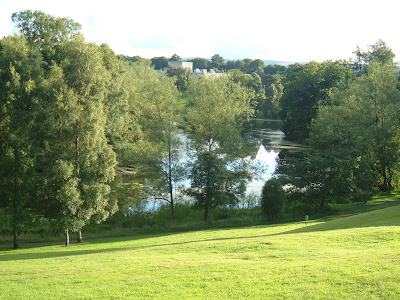
Meanwhile, for anyone feeling the need, here is a picture of some water.


Tuesday, 5 June 2007

a new blog!

posted by kathy.

This is a blog for Beeston Quakers. It's a new idea and only semi-official, in that no-one said "Don't" when I raised the question after Meeting. For the moment it will be managed by me and Rhiannon. Other volunteers from the Meeting are welcome. So are visitors. If you visit, do feel free to post a comment.

One announcement at Meeting was about the Stop the War protest at the Labour Party's Leadership Conference in Manchester on Sunday 24 June. There are coaches from outside the Salutation Inn, leaving at 9.30 a.m. (£14 waged, £7 unwaged) but you need to book in advance. See the website of Nottingham Stop the War campaign for further details.

But this blog isn't just for external political events. I thought it would be a good idea to include extracts from Quaker and other writings from time to time. As the notice I'm posting is about peace, I thought it would be a good idea to include some early Quaker writings about peace and the peace testimony.

"We…utterly…deny all outward wars and strife and fightings with outward weapons, for any end or under any pretense whatsoever. And this is our testimony to the whole world. … The spirit of Christ, by which we are guided, is not changeable, so as to once command us from a thing as evil and again to move unto it; and we do certainly know, and so testify to the world, that the Spirit of Christ which leads us into all Truth will never move us to fight and war against any man with outward weapons, neither for the kingdom of Christ, nor for any kingdoms of this world."
(George Fox, 1660)


May we look upon our treasures, the furniture of our houses, and our garments, and try whether the seeds of war have nourishment in these our possessions.
(John Woolman, c.1764)


This more recent statement sadly seems relevant today. I don't know if Quakers in 1976 thought such words might one day be applied to the British and United States governments:

"It is a matter of grave anxiety that torture and secret imprisonment are being used by many governments, anti-government groups and others to extract information, to suppress criticism, and to intimidate opposition, so that throughout the world countless numbers of men, women and children are suffering inhuman treatment. We believe in the worth of every individual as a child of God, and that no circumstances whatsoever can justify practices intended to break bodies, minds and spirits.
"Both tortured and torturer are victims of the evil from which no human being is immune. Friends, however, believe that the life and power of God are greater than evil, and in that life and power declare their opposition to all torture. The Society calls on all its members, as well as those of all religious and other organisations, to create a force of public opinion which will oblige those responsible to dismantle everywhere the administrative apparatus which permits or encourages torture, and to observe effectively those international agreements under which its use is strictly forbidden."
(Friends World Committee for Consultation, 1976)


Finally, from the introduction to the Advices and Queries which are sometimes read (just one or two at a time) in Quaker Meetings for Worship:

Our diversity invites us both to speak what we know to be true in our lives and to learn from others. Friends are encouraged to listen to each other in humility and understanding, trusting in the Spirit that goes beyond our human effort and comprehension
.

This seems a good starting point for this blog.