posted by kathz
Online life is still life, as I’ve been reminded by a blogpost from Rhiannon Grant.
I’ve been using the internet for a long while and I’m in a very happy relationship which started online. Other people are much less experienced with the internet and are trying to get used to the different conventions and kinds of contact it offers. Rhiannon’s blogpost, which can be reached by clicking here, offers some helpful advice.
This doesn’t mean we should expect everyone to use the internet. There are still people who have good reasons to stay away from online experiences as well as others for whom it’s impossible. We still need to value the experience and insights of those who stay away from the virtual world. If we care about equality, we need to remember that the most valuable insights we can gain will often come from those who don’t share our experience or perspectives. These are the insights that can help us learn.
We can also help one another by talking about the aspects of online Meeting for Worship and other online encounters that are difficult. For example, I don’t like the idea of everyone else staring at me in my home. This may say something about my working-class origins - I’ve always felt uncomfortable about the way middle-class people spend so much time discussing their own and other people’s home decor. I’m also lousy at housework. Other people may have other concerns - about how they look or sound or about the difficulty of socialising in a large group when Meeting has ended.
If we’re concerned about equality and building a community in which everyone is valued and loved, we need to be attentive to one another’s concerns and thoughtful about how we respond. It’s not easy to express a lack of confidence when others seem secure. And it’s worth remembering that equality is very hard to practise in a world where inequality is taken for granted.
Sunday, 3 May 2020


Sunday, 26 April 2020
Technical Glitches
posted by kathz
In the past fortnight, online Meetings have not all gone well for me. There have been some really good Meetings that nourished me. But there have also been occasions when i couldn't get past the technical glitches.
For one Zoom Meeting for Worship, I couldn't get the video linkup to work for half an hour. For another it didn't work at all. And when I tried a Meeting using adobe connect it kept failing - and I couldn't, in the short time when the connection was good, work out how to manage the video or the microphone.
It's hard to express how painful it is to try to attend a Meeting for Worship and then be distracted or turned away by a technological glitch. It's as though I came to a Meeting House and was told I couldn't go in, or entered a Meeting and was continually distracted by someone whispering in my ear and my own stomach rumbling.
But it has made me think more about those without the technology to attend, or those who choose instead to find stillness on their own. I haven't got a pat solution to offer. Those who find stillness on their own may yet find a way of sharing what they find with the wider Meeting.
The question of those who can't attend for other reasons is one which concerns me more deeply. There are many reasons why people might be unable to join any online Meeting for Worship. These reasons include poverty (the technological equipment and the broadband or data necessary all cost money); a crowded household in which a shared time of stillness would impinge unfairly on others and their needs; and a situation of abuse in which that time of stillness with others will be either prevented or punished by physical or psychological violence.
All these things - poverty, a crowded household with demands, and abusive relationships - affect members of the Quaker community and those who would wish to worship with us. Quite often those in such circumstances feel unable to share those aspects of their lives. And, as a Quaker community, we are poorer for not hearing from them. It is possible that they have spiritual insights which we are currently losing. It is possible that hearing of their experience - their expertise on their own circumstances - could teach the rest of us.
I don't have a solution to this. I wish I did.
In the past fortnight, online Meetings have not all gone well for me. There have been some really good Meetings that nourished me. But there have also been occasions when i couldn't get past the technical glitches.
For one Zoom Meeting for Worship, I couldn't get the video linkup to work for half an hour. For another it didn't work at all. And when I tried a Meeting using adobe connect it kept failing - and I couldn't, in the short time when the connection was good, work out how to manage the video or the microphone.
It's hard to express how painful it is to try to attend a Meeting for Worship and then be distracted or turned away by a technological glitch. It's as though I came to a Meeting House and was told I couldn't go in, or entered a Meeting and was continually distracted by someone whispering in my ear and my own stomach rumbling.
But it has made me think more about those without the technology to attend, or those who choose instead to find stillness on their own. I haven't got a pat solution to offer. Those who find stillness on their own may yet find a way of sharing what they find with the wider Meeting.
The question of those who can't attend for other reasons is one which concerns me more deeply. There are many reasons why people might be unable to join any online Meeting for Worship. These reasons include poverty (the technological equipment and the broadband or data necessary all cost money); a crowded household in which a shared time of stillness would impinge unfairly on others and their needs; and a situation of abuse in which that time of stillness with others will be either prevented or punished by physical or psychological violence.
All these things - poverty, a crowded household with demands, and abusive relationships - affect members of the Quaker community and those who would wish to worship with us. Quite often those in such circumstances feel unable to share those aspects of their lives. And, as a Quaker community, we are poorer for not hearing from them. It is possible that they have spiritual insights which we are currently losing. It is possible that hearing of their experience - their expertise on their own circumstances - could teach the rest of us.
I don't have a solution to this. I wish I did.
Thursday, 16 April 2020
Helplessness
posted by kathz
I'm used to being a helper. I'm used to doing things for other people. And suddenly the best I can do for others is nothing at all - or what seems like nothing at all. At the same time lots of people - often people whose work has been barely noticed - are doing a great deal to help people like me. They are the shelf-stackers, the shop assistants, the cleaners, the transport workers, the people who make deliveries and so many others as well as the porters, pharmacists, care workers, nurses, doctors and others within the health and social care sectors. Members of the armed forces - now working to build hospitals that may save lives - are doing more than I am. I'm mostly staying home.
At home I have enough to eat. I can cope with the lack of flour or tinned tomatoes. I'm warm. I'm safe. Others are going without food, have no home or are in places that are not safe. I am privileged.
I am privileged without the power to help anyone or to change the world.
As a Quaker and as a human being I care about equality. At the moment Quakers in Britain are considering questions of privilege and inclusion and it is an uncomfortable process. No-one likes to be reminded that they are more privileged than others - and people who are less privileged often find it painful to talk about their experiences of exclusion. Some people will argue that privilege is allied to power and that power can be used to achieve change for good. They can point to cases where this has happened.
The effects of the Covid-19 virus remind me how profoundly unequal society is in Britain and in the wider world. My privilege is not earned. It is a matter of luck - and it isn't accompanied by power.
Some of the people doing vital work at the moment may be among those who lack a safe place to live. They may be dependent on food banks. At the same time they are risking their lives for people like me.
Helplessness is hard to live with. How much more pleasant it is to help people than to receive help. But if I'm able to to offer help again, I hope I remember this experience of helplessness. I may find I know a little more about how those needing help feel. I must remember that those needing help may be among those who worked to save lives or make other people's lives bearable.
As Quakers, we look for that of God in everyone. We need to see what we can learn from the words and experience of others, whether or not they are Quakers. We don't own the whole truth - we are seekers. And we don't practise equality yet thought we value it - we're just trying to get there. Helplessness may turn out to help me on the way.
I'm used to being a helper. I'm used to doing things for other people. And suddenly the best I can do for others is nothing at all - or what seems like nothing at all. At the same time lots of people - often people whose work has been barely noticed - are doing a great deal to help people like me. They are the shelf-stackers, the shop assistants, the cleaners, the transport workers, the people who make deliveries and so many others as well as the porters, pharmacists, care workers, nurses, doctors and others within the health and social care sectors. Members of the armed forces - now working to build hospitals that may save lives - are doing more than I am. I'm mostly staying home.
At home I have enough to eat. I can cope with the lack of flour or tinned tomatoes. I'm warm. I'm safe. Others are going without food, have no home or are in places that are not safe. I am privileged.
I am privileged without the power to help anyone or to change the world.
As a Quaker and as a human being I care about equality. At the moment Quakers in Britain are considering questions of privilege and inclusion and it is an uncomfortable process. No-one likes to be reminded that they are more privileged than others - and people who are less privileged often find it painful to talk about their experiences of exclusion. Some people will argue that privilege is allied to power and that power can be used to achieve change for good. They can point to cases where this has happened.
The effects of the Covid-19 virus remind me how profoundly unequal society is in Britain and in the wider world. My privilege is not earned. It is a matter of luck - and it isn't accompanied by power.
Some of the people doing vital work at the moment may be among those who lack a safe place to live. They may be dependent on food banks. At the same time they are risking their lives for people like me.
Helplessness is hard to live with. How much more pleasant it is to help people than to receive help. But if I'm able to to offer help again, I hope I remember this experience of helplessness. I may find I know a little more about how those needing help feel. I must remember that those needing help may be among those who worked to save lives or make other people's lives bearable.
As Quakers, we look for that of God in everyone. We need to see what we can learn from the words and experience of others, whether or not they are Quakers. We don't own the whole truth - we are seekers. And we don't practise equality yet thought we value it - we're just trying to get there. Helplessness may turn out to help me on the way.
Wednesday, 15 April 2020
Online first-timers
posted by kathz
I've been wondering what it's like to attend your first Quaker Meeting online - and how best to welcome newcomers to an online Meeting. This post doesn't have easy answers but it does attempt to give some advice on how a newcomer might approach an online Meeting for Worship.
If you came to your first Meeting for Worship before lockdown, you were probably welcomed at the door. You might have been given a leaflet about what happens in Meeting. Even if you arrived a little late, there would still be someone on the door. You would have the opportunity to ask questions - and then there would be a chance for more conversation and questions after Meeting, usually over tea and biscuits.
Online Meetings can't do this. There might be a short opportunity for chat if you get there early - but there will probably be a fair number of other people, making conversation difficult. And if you're a little late - or quite a lot late - as may easily happen with a tricky internet connection, you are plunged straight into the experience of being silent while seeing the faces of strangers. And faces seen on the internet rarely seen as friendly or approachable as faces encountered in real life.
But you may still want to join an online Meeting for Worship - and you would be very welcome to do so. I'm going to make a few suggestions about how you might approach it. These are based on my own experience and they are not the only possibilities.
First of all, once you have got through the technicalities and arrived, try to settle into the silence. It won't be complete silence. There are always other sounds. You may, if you're lucky, hear birdsong. It may be traffic, voices from outside or a dog barking. Take these sounds into the stillness with you.
Being in Meeting for Worship is often about listening - but that doesn't mean straining to listen. It's a kind of openness to what may come. Don't worry if your thoughts wander or if worries come to mind in the stillness - perhaps that wandering or coming face to face with a worry is what you need to happen. Let it be there and try to rest in the stillness you are sharing with others.
Don't worry if you become restless or if you lose a sense of the stillness. This happens to all of us from time to time. Gradually take yourself back into any stillness you may find. Try to be comfortable despite the technological apparatus.
Someone may speak - it's what we call "ministry" - and this should be because they feel led by the Spirit to do so. Ministry isn't for the individual alone but for someone else or some others in the Meeting. It may respond to your needs. If it doesn't, think it possible that someone else in the Meeting is helped by what is being said. And if you feel an overwhelming urge to minister, try to do so clearly and briefly (remembering to unmute your microphone before you speak and to must it again when you have finished).
Online Meetings usually have an opportunity for conversation at the end. You may welcome this or wish to reflect on your own. Choose whatever is right for you.
Many Meetings, like Beeston, have gone online for the first time and Quakers are still getting used to the experience. Woodbrooke Quaker College in Birmingham have been holding online Meetings for a long time and have added a number of new times. These often include Quakers from other countries and in different time zones. They use Zoom and Adobe Connect. If you want to find out about their Meetings for Worship, click on this link.
You may also enjoy hearing what some young Quakers have to say about Meeting for Worship in this short video.
I've been wondering what it's like to attend your first Quaker Meeting online - and how best to welcome newcomers to an online Meeting. This post doesn't have easy answers but it does attempt to give some advice on how a newcomer might approach an online Meeting for Worship.
If you came to your first Meeting for Worship before lockdown, you were probably welcomed at the door. You might have been given a leaflet about what happens in Meeting. Even if you arrived a little late, there would still be someone on the door. You would have the opportunity to ask questions - and then there would be a chance for more conversation and questions after Meeting, usually over tea and biscuits.
Online Meetings can't do this. There might be a short opportunity for chat if you get there early - but there will probably be a fair number of other people, making conversation difficult. And if you're a little late - or quite a lot late - as may easily happen with a tricky internet connection, you are plunged straight into the experience of being silent while seeing the faces of strangers. And faces seen on the internet rarely seen as friendly or approachable as faces encountered in real life.
But you may still want to join an online Meeting for Worship - and you would be very welcome to do so. I'm going to make a few suggestions about how you might approach it. These are based on my own experience and they are not the only possibilities.
First of all, once you have got through the technicalities and arrived, try to settle into the silence. It won't be complete silence. There are always other sounds. You may, if you're lucky, hear birdsong. It may be traffic, voices from outside or a dog barking. Take these sounds into the stillness with you.
Being in Meeting for Worship is often about listening - but that doesn't mean straining to listen. It's a kind of openness to what may come. Don't worry if your thoughts wander or if worries come to mind in the stillness - perhaps that wandering or coming face to face with a worry is what you need to happen. Let it be there and try to rest in the stillness you are sharing with others.
Don't worry if you become restless or if you lose a sense of the stillness. This happens to all of us from time to time. Gradually take yourself back into any stillness you may find. Try to be comfortable despite the technological apparatus.
Someone may speak - it's what we call "ministry" - and this should be because they feel led by the Spirit to do so. Ministry isn't for the individual alone but for someone else or some others in the Meeting. It may respond to your needs. If it doesn't, think it possible that someone else in the Meeting is helped by what is being said. And if you feel an overwhelming urge to minister, try to do so clearly and briefly (remembering to unmute your microphone before you speak and to must it again when you have finished).
Online Meetings usually have an opportunity for conversation at the end. You may welcome this or wish to reflect on your own. Choose whatever is right for you.
Many Meetings, like Beeston, have gone online for the first time and Quakers are still getting used to the experience. Woodbrooke Quaker College in Birmingham have been holding online Meetings for a long time and have added a number of new times. These often include Quakers from other countries and in different time zones. They use Zoom and Adobe Connect. If you want to find out about their Meetings for Worship, click on this link.
You may also enjoy hearing what some young Quakers have to say about Meeting for Worship in this short video.
Saturday, 11 April 2020
Locked down Quakers
posted by Kathy
There was a time, back in the seventeenth century, when it was not unusual for Quakers to be locked up - usually for disturbing the peace, for worshiping in a different way, or for refusing to pay tithes (subscriptions to the Church of England). British Quakers have been locked up since then, most recently for protests against the arms fair or for involvement in Extinction Rebellion. But now we're all under lockdown and what Quakers experience is part of a general imprisonment which we try to endure for the sake of the greater good.
Conditions of our locked down lives vary. Some are in the highly vulnerable category, so unable to leave their homes at all. Others make the most of their daily walk or bike ride for exercise. Some struggle with mental or physical ill health. Some live in crowded conditions or lack a secure place to call home. Some endure difficult or abusive relationships. Some don't have enough money for food, for electricity - let alone for some of the small pleasures (books, games, etc) that make life feel worth living.
It's important to realise how various our experiences of life under lockdown can be - and how reluctant some of us (even some Quakers) may feel to share the difficulties they are experiencing. That's a sad thing for those of us in more fortunate circumstances because we urgently need to learn from the experiences of others.
Meanwhile Beeston Quakers continue. In the years since I last wrote, Beeston Quakers has grown and, until lockdown, Meetings for Worship averaged around fifteen attending every week - not the same fifteen every week and there are probably between thirty and forty people associated with the Meeting.
But in lockdown we're unable to meet in person. Instead, those of us who are happy to do so gather online and hold Meeting for Worship online via Zoom. That's right - pause for laughter - we actually share silence online! And our Meetings have been mostly silence although there's time and space for chat before and afterwards.
This change in approach has made me think more about what we're doing in our Meetings for Worship and the difference between a Meeting and individual meditation. I don't think the online experience is vital - I know that some Friends choose instead to sit in a quiet place (even a garden if they have one) and experience a sense of connection with others at the usual time for Meeting for Worship. Some Friends don't have the technology to go online or find it unhelpful - having a computer, phone or smartphone has never been a prerequisite for Quaker worship. But I use my netbook and headphones because I like to see the faces of others and know who is worshiping with me - and because I'm lucky enough to have this equipment. Others connect on phones.
So what exactly am I doing? I can't speak for others but I think that what I''m trying to reach is a place of deep listening. Quakers used to say they were listening for God's guidance but that's a tricky phrase - whatever God is or may be has become caught up in the limitations of human imagination and what I'm talking about is something much harder to define. Words like "Spirit" or "Light" may be better but I'm really talking about an experience that has always resisted being put into words - or into my words anyway.
I don't just sit down and let this listening happen. I let myself be aware of other people, I notice odd details around me, I let worries and concerns surface and then, very gradually, I find myself slipping into to the deep place of listening. I don't always know I'm doing it. Sometimes it's only when I surface at the end of Meeting that I realise things around me have made a slight rearrangement and I've adjusted my relationship with the world.
Occasionally in Meeting someone is moved to speak. This may be by speaking - and that's not aways clear with my dodgy broadband connection - or they may type into the chat area. I take what I can from this, recognising that what doesn't work for me may, in Quaker-speak, speak to someone else's condition. Or I may be filled with an overpowering urge to say something or read something - often something that arrives quite suddenly in Meeting and that wasn't on my mind before. When that happens, I speak as clearly and briefly as I can - but I may let the words order themselves in my mind before I begin so that it's clear to others. When the words order themselves, I find myself stripping out the inessentials.
Of course, online Meeting has its technical problems - microphones that need to be muted, video connections that fail. And it can be hard to find a quiet space. But some people will also worship with cats, dogs and small children around them, or may choose to join a Meeting just for the few minutes or half hour they have.
Online Meetings for Worship are taking place all around the country and elsewhere. They may include friends abroad and people whose disabilities have previously prevented them from reaching a Meeting. It's not the same as attending a Meeting in the same physical space as other people - but it's not as different as I feared it might be.
There was a time, back in the seventeenth century, when it was not unusual for Quakers to be locked up - usually for disturbing the peace, for worshiping in a different way, or for refusing to pay tithes (subscriptions to the Church of England). British Quakers have been locked up since then, most recently for protests against the arms fair or for involvement in Extinction Rebellion. But now we're all under lockdown and what Quakers experience is part of a general imprisonment which we try to endure for the sake of the greater good.
Conditions of our locked down lives vary. Some are in the highly vulnerable category, so unable to leave their homes at all. Others make the most of their daily walk or bike ride for exercise. Some struggle with mental or physical ill health. Some live in crowded conditions or lack a secure place to call home. Some endure difficult or abusive relationships. Some don't have enough money for food, for electricity - let alone for some of the small pleasures (books, games, etc) that make life feel worth living.
It's important to realise how various our experiences of life under lockdown can be - and how reluctant some of us (even some Quakers) may feel to share the difficulties they are experiencing. That's a sad thing for those of us in more fortunate circumstances because we urgently need to learn from the experiences of others.
Meanwhile Beeston Quakers continue. In the years since I last wrote, Beeston Quakers has grown and, until lockdown, Meetings for Worship averaged around fifteen attending every week - not the same fifteen every week and there are probably between thirty and forty people associated with the Meeting.
But in lockdown we're unable to meet in person. Instead, those of us who are happy to do so gather online and hold Meeting for Worship online via Zoom. That's right - pause for laughter - we actually share silence online! And our Meetings have been mostly silence although there's time and space for chat before and afterwards.
This change in approach has made me think more about what we're doing in our Meetings for Worship and the difference between a Meeting and individual meditation. I don't think the online experience is vital - I know that some Friends choose instead to sit in a quiet place (even a garden if they have one) and experience a sense of connection with others at the usual time for Meeting for Worship. Some Friends don't have the technology to go online or find it unhelpful - having a computer, phone or smartphone has never been a prerequisite for Quaker worship. But I use my netbook and headphones because I like to see the faces of others and know who is worshiping with me - and because I'm lucky enough to have this equipment. Others connect on phones.
So what exactly am I doing? I can't speak for others but I think that what I''m trying to reach is a place of deep listening. Quakers used to say they were listening for God's guidance but that's a tricky phrase - whatever God is or may be has become caught up in the limitations of human imagination and what I'm talking about is something much harder to define. Words like "Spirit" or "Light" may be better but I'm really talking about an experience that has always resisted being put into words - or into my words anyway.
I don't just sit down and let this listening happen. I let myself be aware of other people, I notice odd details around me, I let worries and concerns surface and then, very gradually, I find myself slipping into to the deep place of listening. I don't always know I'm doing it. Sometimes it's only when I surface at the end of Meeting that I realise things around me have made a slight rearrangement and I've adjusted my relationship with the world.
Occasionally in Meeting someone is moved to speak. This may be by speaking - and that's not aways clear with my dodgy broadband connection - or they may type into the chat area. I take what I can from this, recognising that what doesn't work for me may, in Quaker-speak, speak to someone else's condition. Or I may be filled with an overpowering urge to say something or read something - often something that arrives quite suddenly in Meeting and that wasn't on my mind before. When that happens, I speak as clearly and briefly as I can - but I may let the words order themselves in my mind before I begin so that it's clear to others. When the words order themselves, I find myself stripping out the inessentials.
Of course, online Meeting has its technical problems - microphones that need to be muted, video connections that fail. And it can be hard to find a quiet space. But some people will also worship with cats, dogs and small children around them, or may choose to join a Meeting just for the few minutes or half hour they have.
Online Meetings for Worship are taking place all around the country and elsewhere. They may include friends abroad and people whose disabilities have previously prevented them from reaching a Meeting. It's not the same as attending a Meeting in the same physical space as other people - but it's not as different as I feared it might be.
Wednesday, 20 December 2017
Handing over to new writers
As you can see, this blog has lacked posts for some long time while I have been busy with work. Rhiannon, whose posts many enjoyed, is now at Woodbrooke College as a tutor in Quaker roles. You can find her elsewhere in the Quaker blogosphere.
However readers of this blog may be pleased to learn that Beeston is now a growing Quaker Meeting and that one of our newer members has expressed an interest in taking over the blog. If asked, I may occasionally pop up as a contributor.
I hope that readers will return as new posts are added - and that you may also be interested in various new activities, including podcasting.
Meanwhile, if you're ever in Beeston, Notts on a Sunday morning and feel like dropping in, be assured of a friendly greeting, an hour of stillness and a choice of hot beverages and biscuits to follow.
Kathy
However readers of this blog may be pleased to learn that Beeston is now a growing Quaker Meeting and that one of our newer members has expressed an interest in taking over the blog. If asked, I may occasionally pop up as a contributor.
I hope that readers will return as new posts are added - and that you may also be interested in various new activities, including podcasting.
Meanwhile, if you're ever in Beeston, Notts on a Sunday morning and feel like dropping in, be assured of a friendly greeting, an hour of stillness and a choice of hot beverages and biscuits to follow.
Kathy
Tuesday, 30 December 2014
City of Sanctuary - the Birmingham Declaration
One of the central concerns of Quakers is to look for that of God in everyone. This is, I think, at the heart of some of our testimonies, including those for peace and equality. Quakers naturally differ in their understanding of God but they recognize that there is something they might term "the divine" or "the inner light" in all human beings. This doesn't mean that all human beings act well, since obviously they don't, but that there is something in human beings that we can, at the very least, try to nurture and address.
It is not surprising that Quakers have, for a long time, been concerned to help asylum seekers, refugees and migrants. Quakerism has its roots in Christianity, a religion which has numerous stories of refugees and migration (as do very many religions). The flight of Mary, Joseph and the baby Jesus is a well-known example. Similarly the disciples of Jesus became migrants. Quakers are now praised for the assistance they gave to refugees in the 1930s but this was not always a popular course of action.
Current hatred and fear of migrants is disturbing. I don't think the majority of the population feel hate and fear towards the individuals they encounter but it's easy to fear the unknown - and the media frequently treat vulnerable migrants as a mass who lack individual human characteristics.
The City of Sanctuary movement calls for hospitality towards asylum seekers, refugees and migrants. Recently it has asked groups to put their names to the "Birmingham Declaration." Beeston Quakers are very happy to sign this Declaration. The text can be found below. If you are a member of a group which would like to sign this declaration, it's easy to do so using this link.

It is not surprising that Quakers have, for a long time, been concerned to help asylum seekers, refugees and migrants. Quakerism has its roots in Christianity, a religion which has numerous stories of refugees and migration (as do very many religions). The flight of Mary, Joseph and the baby Jesus is a well-known example. Similarly the disciples of Jesus became migrants. Quakers are now praised for the assistance they gave to refugees in the 1930s but this was not always a popular course of action.
Current hatred and fear of migrants is disturbing. I don't think the majority of the population feel hate and fear towards the individuals they encounter but it's easy to fear the unknown - and the media frequently treat vulnerable migrants as a mass who lack individual human characteristics.
The City of Sanctuary movement calls for hospitality towards asylum seekers, refugees and migrants. Recently it has asked groups to put their names to the "Birmingham Declaration." Beeston Quakers are very happy to sign this Declaration. The text can be found below. If you are a member of a group which would like to sign this declaration, it's easy to do so using this link.
City of Sanctuary - Birmingham Declaration
Britain has a long tradition of offering
protection to those fleeing persecution, many of whom have gone on to
make a considerable contribution to our society. It also has a
reputation for fairness and justice that is the envy of many other
nations.
We believe that the great majority of British people are sympathetic towards those who come here seeking help and protection.
We have come together in Birmingham on 15th
November 2014 in recognition that the position of refugees and migrants
is aggravated in Europe and in Britain in an unprecedented way. We can
no longer just watch in silence as millions flee Syria only to be
warehoused in refugee camps and thousands drown in desperate attempts to
reach the Western world across the sea. This is a matter of life and
death.
We commit ourselves to work together to ensure that our great country continues to be a safe place for those fleeing persecution and a welcoming place for all people who come here to study, work or join family and who will work alongside us to build a just and fair society.
We commit ourselves today to a core set of principles and asks that will strengthen our collective efforts to protect the rights of strangers amongst us. Through these commitments we seek accountability and justice. We are asking our Parliament and our Government to take necessary steps to deliver that change.
These commitments tackle the causes and consequences of the very vulnerable position refugees and migrants find themselves in. They are within the scope of the international protection framework that Britain has been signatory to for decades.
Recognising that we all have a role to play, we are asking our Government to do all they can to ensure that:
1. All asylum seekers, refugees and migrants should be treated with dignity and respect.
We ask that the debate on immigration is conducted with care for the dignity of people who are vulnerable, who do not have a voice in the public domain and who have to suffer the consequences of inaccurate and inflammatory language. We appeal to all politicians and to the media to conduct the pre-election debate responsibly, sticking to the facts and bearing these principles in mind.
We commit ourselves to work together to ensure that our great country continues to be a safe place for those fleeing persecution and a welcoming place for all people who come here to study, work or join family and who will work alongside us to build a just and fair society.
We commit ourselves today to a core set of principles and asks that will strengthen our collective efforts to protect the rights of strangers amongst us. Through these commitments we seek accountability and justice. We are asking our Parliament and our Government to take necessary steps to deliver that change.
These commitments tackle the causes and consequences of the very vulnerable position refugees and migrants find themselves in. They are within the scope of the international protection framework that Britain has been signatory to for decades.
Recognising that we all have a role to play, we are asking our Government to do all they can to ensure that:
1. All asylum seekers, refugees and migrants should be treated with dignity and respect.
We ask that the debate on immigration is conducted with care for the dignity of people who are vulnerable, who do not have a voice in the public domain and who have to suffer the consequences of inaccurate and inflammatory language. We appeal to all politicians and to the media to conduct the pre-election debate responsibly, sticking to the facts and bearing these principles in mind.
2. A fair and effective process to decide whether people need protection should be in place.
We ask for a high standard of decision making on refugee protection cases. After years of very public failure, we demand a system that is fair and efficient and ensures protection for those who need it. People should have access to good quality legal advice and representation during the process, publicly funded when they are unable to pay. Not everyone is entitled to refugee status in Britain, but they are entitled to a fair process to determine if they are in need of protection.
We ask for a high standard of decision making on refugee protection cases. After years of very public failure, we demand a system that is fair and efficient and ensures protection for those who need it. People should have access to good quality legal advice and representation during the process, publicly funded when they are unable to pay. Not everyone is entitled to refugee status in Britain, but they are entitled to a fair process to determine if they are in need of protection.
3. No one should be locked up indefinitely.
We seek an end to the indefinite detention of asylum seekers and migrants. No one should be deprived of their liberty with no judicial oversight. Indefinite detention is unacceptable, costly and ineffective. We ask for a reasonable time limit to be introduced and other safeguards put in place to ensure the lawfulness and fairness within the system.
We seek an end to the indefinite detention of asylum seekers and migrants. No one should be deprived of their liberty with no judicial oversight. Indefinite detention is unacceptable, costly and ineffective. We ask for a reasonable time limit to be introduced and other safeguards put in place to ensure the lawfulness and fairness within the system.
4. No one should be left sick or destitute in our society.
It cannot be right that people are left destitute in modern Britain, banned from working but denied support. Until they are granted protection and can work, asylum seekers should receive sufficient support to meet their essential living needs while in the UK. We are asking that those whose cases have taken more than six months to resolve, or who have been refused but are unable to return home, should receive permission to work. All of them should be allowed free access to NHS services
It cannot be right that people are left destitute in modern Britain, banned from working but denied support. Until they are granted protection and can work, asylum seekers should receive sufficient support to meet their essential living needs while in the UK. We are asking that those whose cases have taken more than six months to resolve, or who have been refused but are unable to return home, should receive permission to work. All of them should be allowed free access to NHS services
5. We should welcome the stranger and help them to integrate.
People should integrate, and we should help them to do so. We are asking for support for asylum seekers to be welcomed and befriended on arrival. To help them integrate and participate in the local community they should be able to learn English, with free tuition provided where needed.
People should integrate, and we should help them to do so. We are asking for support for asylum seekers to be welcomed and befriended on arrival. To help them integrate and participate in the local community they should be able to learn English, with free tuition provided where needed.
We make a commitment to take action on these
principles and asks together and translate them into collaborative
actions in our organisations and communities locally and nationally in
the run up to the next general elections and beyond.
We commit ourselves to work strategically
together. We will come back next year to check our progress against
these principles and asks and make plans for what needs to be done in
the future, together. Below are the first of what we believe will be
hundreds of organisations signing this declaration.
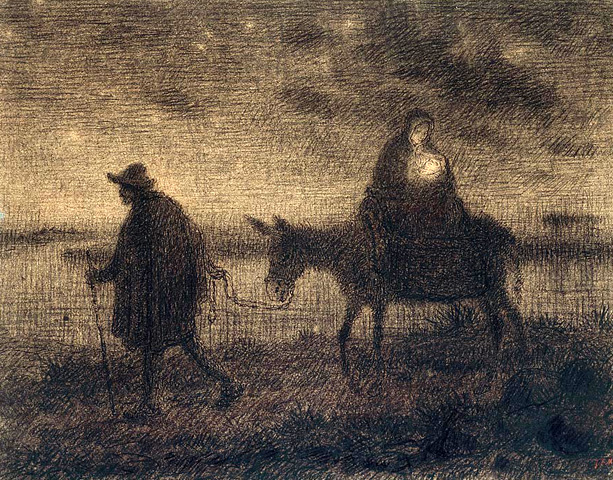
(Flight into Egypt by Millais)
Reviving the Blog
posted by Kathy
As the blogger for Beeston Quakers, I've been more than a little slow in posting. Family matters and work have occupied me. I shall do my best to blog from time to time and, if I can, to recruit a further blogger or two.
Meanwhile it's good to report that the Meeting is happily settled in the Chilwell Memorial Hall and that attendance, after a dip, has begun to grow again. This doesn't make us a large Meeting but it's been good to welcome new members and attenders who bring insights and enlarge our ways of seeing and understanding.
We continue to welcome visitors - and invite them to join us for hot drinks (tea, coffee, herbal tea) and biscuits after Meeting for Worship. If you would like to join us and see what a Quaker Meeting is like, do come along. There is no cost or obligation to coming along and you will be very welcome.
As the blogger for Beeston Quakers, I've been more than a little slow in posting. Family matters and work have occupied me. I shall do my best to blog from time to time and, if I can, to recruit a further blogger or two.
Meanwhile it's good to report that the Meeting is happily settled in the Chilwell Memorial Hall and that attendance, after a dip, has begun to grow again. This doesn't make us a large Meeting but it's been good to welcome new members and attenders who bring insights and enlarge our ways of seeing and understanding.
We continue to welcome visitors - and invite them to join us for hot drinks (tea, coffee, herbal tea) and biscuits after Meeting for Worship. If you would like to join us and see what a Quaker Meeting is like, do come along. There is no cost or obligation to coming along and you will be very welcome.
Friday, 3 August 2012
The August break
The Memorial Hall is becoming a familiar place for Beeston Quakers. We have seen new visitors in the past few months and were particularly pleased to welcome a baby last Sunday. We have grown accustomed to the hall and the kitchen and adjacent rooms.
However we remain a small Meeting and depend of a core of a few members and attenders. We have therefore decided that we shall not hold Meeting for Worship in Beeston during August 2012.
There are Quaker Meetings in Nottingham, Derby and Loughborough which should welcome visitors (though it may be necessary to find out about facilities and Meeting for children in advance).
Meeting in Beeston in the Chilwell Memorial Hall resumes at 10.30 on Sunday, 2nd September and will welcome visitors.

Friday, 23 December 2011
Next Meeting for Worship is on 8th January, 2012
We have consulted everyone at Meeting and on our e-mail list and discovered that almost everyone is away or busy on Christmas Day and New Year's Day. Our next Meeting for Worship will therefore be at 10.30 a.m. on Sunday, 8th January 2012.
We are now feeling very settled in the Chilwell Memorial Hall and enjoy our Meetings there.
We are now feeling very settled in the Chilwell Memorial Hall and enjoy our Meetings there.
Saturday, 22 October 2011
Beeston Quakers have moved

posted by Kathy
Beeston Quakers will be meeting in Chilwell Memorial Hall for the next month - and possibly for a long time to come. The hall seems to meet all our needs so we're trying it out, starting on Sunday 23rd October at 10.30 a.m. As always, visitors are welcome. Meeting for Worship lasts an hour and is mostly (sometimes entirely) silent. It is followed by notices after which we usually share hot drinks, biscuits and friendly conversation.
The memorial hall is at 129, High Road, Chilwell (near the turnings off to Cator Lane and Meadow Lane). You can find a map HERE.
Some people may find it strange that Quakers meet in a hall commemorating soldiers who died in the First World War but I think it right to remember all those who died in war. John Woolman, the 18th-century Quaker who refused to pay taxes for war, offers a more pertinent challenge. In his essay "A Plea for the Poor" he calls on Quakers to look at their own possessions and "try whether the seeds of war have any nourishment in them."
I think Beeston Quakers will also feel content that the original principles laid down by the trustees of the memorial hall included these:
“That the Institute shall be used as a club or place of assembly for the inhabitants of Chilwell and the neighbourhood and that in determining what persons or class of persons shall be entitled to use the Institute no regard shall be had to or distinction made on grounds of religious discrimination, political opinions or sex.”
I reckon that chimes well with Quakers' testimony to equality.
Sunday, 25 September 2011
Quaker Meetings in Beeston Fire Station until 16th October
We have booked into Beeston Fire Station until and including Sunday, 16th October. Please see the post below for details of location and map. Ideas for a suitable long-term home for our Sunday morning Meeting for Worship are still welcome.
Wednesday, 7 September 2011
Wandering Friends
We've been very happy meeting in the Middle Street Resource Centre for nearly twenty years. However new arrangements by the council mean that we are currently homeless, at rather short notice.
On Sunday 11th September we shall hold Meeting for Worship at 10.30 at the new Fire Station in Hassocks Lane, NG9 2GQ. Hassocks Lane is a turning off Queens Road East (the A6005) quite close to Highfields (the University Park).
View Larger Map
If you click on the map you should be able to zoom in and find the street.
All attending will be very welcome.
In the meantime, we need suggestions for the long-term.
Our primary requirements are: a comfortable, fairly quiet room where 15-20 people can meet, ideally sitting in a circle or similar arrangement with books on the centre table. It needs to be available between 10 and 12.30 on Sunday mornings every week.
We would very much like to be able to make and offer hot and cold drinks for attenders after meeting so access to a kettle would help.
Sometimes people bring children to Meeting and it would help to have a small, comfortable room for children to engage in activities with adult care/supervision. The age of the children could vary but it would be unusual for more than four to attend in a single week.
It's important that the venue has access for people with disabilities.
Ideally we would like to be able to leave a large box at the venue between Meetings. This contains mugs, equipment for hot drinks, a tin a biscuits, a first aid kit and a few books and leaflets.
We would like to be able to display a sign while meeting (perhaps in a window) so that people can see where we are. It would be good (but not essential) if we could have a poster up at other times.
If you know of any venue in the Beeston/Chilwell area that might suit us, please post a comment or email beestonquakers@yahoo.co.uk It would help to know how much any venue is likely to charge.
Meanwhile, for updates on our search for somewhere to meet, and details of arrangements on a weekly basis, please watch this blog.
On Sunday 11th September we shall hold Meeting for Worship at 10.30 at the new Fire Station in Hassocks Lane, NG9 2GQ. Hassocks Lane is a turning off Queens Road East (the A6005) quite close to Highfields (the University Park).
View Larger Map
If you click on the map you should be able to zoom in and find the street.
All attending will be very welcome.
In the meantime, we need suggestions for the long-term.
Our primary requirements are: a comfortable, fairly quiet room where 15-20 people can meet, ideally sitting in a circle or similar arrangement with books on the centre table. It needs to be available between 10 and 12.30 on Sunday mornings every week.
We would very much like to be able to make and offer hot and cold drinks for attenders after meeting so access to a kettle would help.
Sometimes people bring children to Meeting and it would help to have a small, comfortable room for children to engage in activities with adult care/supervision. The age of the children could vary but it would be unusual for more than four to attend in a single week.
It's important that the venue has access for people with disabilities.
Ideally we would like to be able to leave a large box at the venue between Meetings. This contains mugs, equipment for hot drinks, a tin a biscuits, a first aid kit and a few books and leaflets.
We would like to be able to display a sign while meeting (perhaps in a window) so that people can see where we are. It would be good (but not essential) if we could have a poster up at other times.
If you know of any venue in the Beeston/Chilwell area that might suit us, please post a comment or email beestonquakers@yahoo.co.uk It would help to know how much any venue is likely to charge.
Meanwhile, for updates on our search for somewhere to meet, and details of arrangements on a weekly basis, please watch this blog.
Thursday, 29 July 2010
Meeting in August - and afterwards
posted by kathy
For many years, Beeston Quakers haven't met together in August. This started because it was hard to organise when many members had young families and it gave the small core of Beeston Quakers, who took responsibility for the Meeting week after week, a chance to enjoy other weekend activities and to attend other Meetings.
The people involved with any Meeting change over the years and so do their needs and commitments. This August we're experimenting. There will be a Sunday Meeting for Worship on the first three Sundays in August (the 1st, 8th and 15th) at 10.30 a.m. (but not on the last two Sundays). Visitors are, as always, welcome.
Meanwhile there's a danger that the Day Centre (properly the Middle Street Resource Centre) where we meet will be closed in the current round of County Council cuts. This won't be a disaster for Beeston Quakers who can move to another building or attend other Meetings. However it presents a serious problem for the people who use the Centre in the week - and they're busy campaigning against it.
 The Middle Street Resource Centre is used by people with mental health difficulties - and, judging from what we see at Meeting on Sundays, it's well used. In the time we've been meeting there - 18 years, I think - we've seen the centre grow from a functional institution to a place that is loved and cared for by its users. We've seen and enjoyed the wonderful gardens that have been planted. We've read the notices on the walls and seen the signs of a supportive social life in which the people who come to the centre help and teach one another. We've seen that people do art and creative writing, go on outings together, learn a huge range of subjects. It's a place which people value - and where they feel valued. The centre is a living witness to what we as Quakers recognise as "that of God in every one" - though the users of the centre would probably have different language to describe it. The centre as it is now doesn't feel like a place of difficulty and illness but a place of healing and health.
Visiting the centre on Sundays, we've read the notices and information about mental health on the walls and tables and have become much better informed. Some of us have talked about our own experiences. 1 in 4 of the population have mental health difficulties at some point in their lives - the centre helps people with the kind of problems that everyone encounters in themselves, their families or friends. I've never seen a centre set up to help people that so evidently does a good job.
The county council is proposing to give centre users an individual account so that they can still get help. But this would deprive the users of the support they have now and the network of friendships they have built up. The centre is a sociable place. It feels loved.
The users are campaigning to keep the centre which means so much to them - and to which they have given such care. Readers of this blog may wish to sign their petition. There's a copy in the Oxfam shop on Beeston High Road and you can also sign it on-line, HERE.
For many years, Beeston Quakers haven't met together in August. This started because it was hard to organise when many members had young families and it gave the small core of Beeston Quakers, who took responsibility for the Meeting week after week, a chance to enjoy other weekend activities and to attend other Meetings.
The people involved with any Meeting change over the years and so do their needs and commitments. This August we're experimenting. There will be a Sunday Meeting for Worship on the first three Sundays in August (the 1st, 8th and 15th) at 10.30 a.m. (but not on the last two Sundays). Visitors are, as always, welcome.
Meanwhile there's a danger that the Day Centre (properly the Middle Street Resource Centre) where we meet will be closed in the current round of County Council cuts. This won't be a disaster for Beeston Quakers who can move to another building or attend other Meetings. However it presents a serious problem for the people who use the Centre in the week - and they're busy campaigning against it.
 The Middle Street Resource Centre is used by people with mental health difficulties - and, judging from what we see at Meeting on Sundays, it's well used. In the time we've been meeting there - 18 years, I think - we've seen the centre grow from a functional institution to a place that is loved and cared for by its users. We've seen and enjoyed the wonderful gardens that have been planted. We've read the notices on the walls and seen the signs of a supportive social life in which the people who come to the centre help and teach one another. We've seen that people do art and creative writing, go on outings together, learn a huge range of subjects. It's a place which people value - and where they feel valued. The centre is a living witness to what we as Quakers recognise as "that of God in every one" - though the users of the centre would probably have different language to describe it. The centre as it is now doesn't feel like a place of difficulty and illness but a place of healing and health.
Visiting the centre on Sundays, we've read the notices and information about mental health on the walls and tables and have become much better informed. Some of us have talked about our own experiences. 1 in 4 of the population have mental health difficulties at some point in their lives - the centre helps people with the kind of problems that everyone encounters in themselves, their families or friends. I've never seen a centre set up to help people that so evidently does a good job.
The county council is proposing to give centre users an individual account so that they can still get help. But this would deprive the users of the support they have now and the network of friendships they have built up. The centre is a sociable place. It feels loved.
The users are campaigning to keep the centre which means so much to them - and to which they have given such care. Readers of this blog may wish to sign their petition. There's a copy in the Oxfam shop on Beeston High Road and you can also sign it on-line, HERE.
Friday, 2 July 2010
Ethical Dilemmas in the Shops
posted by Rhiannon
This theme may be old to many f/Friends, but I am feeling it afresh, spurred on in part by a green issues home group in Leeds and in part by reading about Cat Chapin-Bishop's plastic fast. In seeking to be ethical consumers, how do we make choices?
Here are three considerations - not the whole picture, but enough to get us started.
On the one hand, I believe in social justice, and that movements such as Fairtrade are worth supporting.
On the other hand, I see good reasons to think that we need to reduce our use of fossil fuels, and hence of fossil fuel powered transport, plastic, and other related products.
And in a third corner, sitting behind me because I am reluctant to admit to it, I have a need to look after myself to a certain extent: to feed myself healthy food at a reasonable price, to travel sometimes, to use products which come in plastic packets.
Now let me tell about my local supermarket. It's the cheapest place with the widest selection within a walking distance which is reasonable at my present level of health. They sell, for example, two kinds of bananas: fairly traded bananas in plastic bags, and ordinary bananas which are loose. (Should I be sad or thankful that they don't complicate this further by selling organic bananas?)
Sometimes I want to buy bananas - I like them and they're good for me. I want to buy fairly traded bananas because, well, I want to be fair. However, I don't want to buy a plastic bag. Which kind do I buy?
For bananas, I have developed an arbitrary mechanism. I like my bananas greener than most people do, and it takes me a week to eat a bunch, so I buy the greenest ones. This seems to produce about the same result as if I flipped a coin to choose between the two kinds.
Needless to say, I find this solution intellectually unsatisfying and non-transferable, although it satisfies the hunger better than not buying bananas at all. Almost every food comes with a similar dilemma: all fresh fruit and veg in the shop is a plastic/fair trade/organic/food miles toss up (I'd grow it, but I rent a house which only has a tiny concrete garden). The frozen veg is in plastic, and though it might be brought by boat rather than plane, freezing requires fuel. Putting things in tins takes energy, too. Pasta, rice, many potatoes, and bread all come in plastic, and who knows how far? I'm vegetarian, but milk and cheese come in plastic, possibly a long way; even if I went vegan, the rice milk or soy milk (which might be GM...) would come in a Tetrapak - as does my fruit juice now. I can drink water but I can't swallow tablets with it, and when you take them every day, you get through juice. In any case, water's good but it's hardly full of vitamins and doesn't count as one of your five a day.
Sometimes this makes me want to throw up my hands in horror and give up eating entirely. Other times, it makes me want to move to a smallholding in Wales and try desperately to grow everything for myself. Mostly, I just sigh and feel a bit guilty while I eat my banana - whichever kind it is.
Which bananas would you buy? Why? What buying choices do you struggle with?
This theme may be old to many f/Friends, but I am feeling it afresh, spurred on in part by a green issues home group in Leeds and in part by reading about Cat Chapin-Bishop's plastic fast. In seeking to be ethical consumers, how do we make choices?
Here are three considerations - not the whole picture, but enough to get us started.
On the one hand, I believe in social justice, and that movements such as Fairtrade are worth supporting.
On the other hand, I see good reasons to think that we need to reduce our use of fossil fuels, and hence of fossil fuel powered transport, plastic, and other related products.
And in a third corner, sitting behind me because I am reluctant to admit to it, I have a need to look after myself to a certain extent: to feed myself healthy food at a reasonable price, to travel sometimes, to use products which come in plastic packets.
Now let me tell about my local supermarket. It's the cheapest place with the widest selection within a walking distance which is reasonable at my present level of health. They sell, for example, two kinds of bananas: fairly traded bananas in plastic bags, and ordinary bananas which are loose. (Should I be sad or thankful that they don't complicate this further by selling organic bananas?)
Sometimes I want to buy bananas - I like them and they're good for me. I want to buy fairly traded bananas because, well, I want to be fair. However, I don't want to buy a plastic bag. Which kind do I buy?
For bananas, I have developed an arbitrary mechanism. I like my bananas greener than most people do, and it takes me a week to eat a bunch, so I buy the greenest ones. This seems to produce about the same result as if I flipped a coin to choose between the two kinds.
Needless to say, I find this solution intellectually unsatisfying and non-transferable, although it satisfies the hunger better than not buying bananas at all. Almost every food comes with a similar dilemma: all fresh fruit and veg in the shop is a plastic/fair trade/organic/food miles toss up (I'd grow it, but I rent a house which only has a tiny concrete garden). The frozen veg is in plastic, and though it might be brought by boat rather than plane, freezing requires fuel. Putting things in tins takes energy, too. Pasta, rice, many potatoes, and bread all come in plastic, and who knows how far? I'm vegetarian, but milk and cheese come in plastic, possibly a long way; even if I went vegan, the rice milk or soy milk (which might be GM...) would come in a Tetrapak - as does my fruit juice now. I can drink water but I can't swallow tablets with it, and when you take them every day, you get through juice. In any case, water's good but it's hardly full of vitamins and doesn't count as one of your five a day.
Sometimes this makes me want to throw up my hands in horror and give up eating entirely. Other times, it makes me want to move to a smallholding in Wales and try desperately to grow everything for myself. Mostly, I just sigh and feel a bit guilty while I eat my banana - whichever kind it is.
Which bananas would you buy? Why? What buying choices do you struggle with?
Tuesday, 1 June 2010
Britain Yearly Meeting 2010: a personal report
posted by Rhiannon
Firstly, I'd like to welcome any visitors who are here because I mentioned this blog in a Yearly Meeting session.
Secondly, I'd like to apologise to Beeston Meeting for writing so little for you in recent months; actually, I have been writing, reams and reams, but it's almost all been essays and papers and my dissertation. I'm enjoying my course, though, and being in Leeds, and Carlton Hill Meeting.
On to today's real topic: Britain Yearly Meeting 2010. This write-up will be rather impressionistic and very personal, and should not be taken as more than that.
I arrived on Friday evening, met my family at Kings Cross, and was instantly swept into Friends House Restaurant and the gathering throng. One of the chief pleasures of Yearly Meeting is seeing again old friends (later in the weekend, I met a woman whom I once knew well, but hadn't seen for at least ten years. Apparently I haven't changed much!), but another of the pleasures is getting to know new people - sometimes old hands whom one hasn't happened to speak to previously, but also those attending for the first time.
The most important business grouped around three topics: our engagement with the political process, our ministries of giving, and the question of allowing journalists to enter Yearly Meeting sessions.
My main reaction to the first two of these was tears. It's good to hear about other Quakers who are engaging in political work internationally, nationally, and at their local level; but my personal engagement with the political process is at the moment extremely frustrating. I don't think this is the forum in which to go into details, but I will just say that I tend to feel misunderstood, alienated, and lacking in power. I'm glad that not all Friends feel this way.
There are, of course, many kinds of giving: those chiefly under consideration are the gifts we make to the Yearly Meeting, which mostly consist of either service or money. I give some service to my Local Meeting, but none nationally unless we count presence at Yearly Meeting itself; as a student, what money I have has been given by someone else and is firmly marked for a specific purpose, so what I can give on a weekly or monthly basis is peanuts (sometimes literally).
The power of the business method was very clear to me in these sessions. To be open in that way, in that great silence, for nearly seven hours a day, is to make oneself very vulnerable. Nowhere is that clearer than when one is called to speak. I spoke twice to the issue about journalism, and one in non-business worship on Monday afternoon.
On Saturday afternoon, we failed to reach clarity about allowing journalists into Yearly Meeting; I felt that the contributions were, taken as a group, confused and fearful - sometimes for good reason, sometimes not - and this showed again on Monday morning. It becomes clear that when many Friends imagine 'a journalist' they are thinking of a man from a daily newspaper, someone who writes, and whose interests are more secular than spiritual. They aren't thinking of the citizen journalist whom the internet has created - they aren't thinking of me - and they aren't thinking of the religion and ethics correspondents who may be Quakers already. They're thinking of people who probably wouldn't want to come anyway: no sensible fashion correspondent is going to sit through a three-hour silent session in order to be able to report that Quakers frequently wear socks with their sandals, and if they did want to report that, they could stand on the Euston Road and find out the same thing in ten minutes.
This was the point to which I was speaking when I mentioned this blog. Some suggestions had implied that journalists were a distinct breed and could be set apart or asked to introduce themselves: what about me? I asked. Do I count as a journalist, since it's been requested that I write a blog post, which will be published for the whole world to see?
In the end - and I think this was the right choice - we have written a minute which sets out that in principle journalists could be allowed to sit in on some sessions of Britain Yearly Meeting, and asked our Clerks, Agenda Committee, and others to consider how best this could be handled. I hope that we will uphold those doing this service as they seek to discern the best advice to give to Friends on maintaining our discipline while meeting non-Quaker journalists and being themselves citizen journalists, the best briefings to give to any professional journalists who do wish to attend, and which sessions will need privacy or be most interesting for a visitor.
I'm tired now - long days, long commutes, and the trembling that goes with ministry will do that - but happy, and feeling empowered and energised to go forward in my own little tiny involvements in local and national politics, interfaith and ecumenical work, and giving what I can when I can. My thanks to everyone who made Yearly Meeting (and my attendance) possible.
Sunday, 25 April 2010
Votes and testimonies
posted by kathy
Sometimes life gets in the way of things we plan to do. I've been busy with work and Rhiannon with her studies. There were things to say, but we didn't say them on this blog. .
There were plenty of conversations in between, especially after Meeting. Lately we've been discussing the general election. We're not unanimous and many of us are undecided. One of today's attenders summed up the question as whether to vote strategically or vote your conscience. I suspect that's a dilemma many voters face.
There's no one party particularly favoured by Quakers. I've known Quakers in all three mainstream English parties as well as a number of fringe parties. Most aren't members of political parties at all but they usually vote, take a strong interest in politics and may support causes where they think they can make a difference.
Quakers don't have a creed or a body of shared beliefs. We do have what we call "testimonies," which are perhaps best explained as areas of concern. We consider these important when making choices and decisions in our own life. They are also important in our relationship as a body to public life and are therefore bound to influence the way we vote and talk to people in positions of power.
There are different interpretations and descriptions of the testimonies but most Quakers in Britain agree on four core testimonies: truth, equality, simplicity and peace. We agreed today to ask the six candidates for Broxtowe to say where they stand on these testimonies and to post their responses as comments to this blog. Tony, a member of our Meeting, has agreed to draw the attention of all the candidates to this blog.
Because the testimonies are broad, it seems sensible to explain how they have currently been interpreted and prompted action among friends.
People are most likely to encounter the Quaker truth testimony in court. Quakers don't swear oaths - they hold that they are required to speak truth all the time and oath-taking implies more than one standard of truth. In the last twenty years, Quakers have been concerned with the question of integrity in public life, including the pressure on public servants to be dishonest in various ways. Last year, when British Quakers finally decided, after 22 years of consideration, to hold same-sex marriages in Meetings just as we hold opposite-sex weddings, the truth testimony was at least as important as the testimony to equality. Those present - about 1700 Quakers - were reminded of George Fox's words on marriage: "This is the Lord's work and we are but witnesses." We saw that our duty was to witness to what we already saw as marriages.
The Quaker testimony on equality is rooted in the belief that there is that of God in everyone. Sometimes this is described as "the Light within." Quakers are as fallible in acting on this testimony as on any other. However the idea that we should see value in all humans has led us to oppose discrimination and cruelty prompted by such differences as race, gender, sexuality and disability. It has also led us to care for justice between individuals, groups and nations. Quakers are involved with prisoners and asylum seekers and have recently been involved in the Circles of Trust scheme, working with dangerous offenders after their release from prison. You may find it helpful to know that many Quakers refuse to use titles and address all people directly by their names.
The Quaker testimony on simplicity seems particularly apt in a time when there are concerns about the depletion of natural resources and damage to the environment. Historically it has also been linked to the testimony to equality with past Quakers, including William Penn and John Woolman, urging Quakers to avoid the acquisition of wealth for its own sake or for the sake of ostentatious display, especially in the face of poverty. Many Quakers are very concerned for the environment and sometimes care for the environment is listed as a separate testimony.
The Quakers' peace testimony is probably the best known. Almost all Quakers are pacifists. This isn't just a matter of refusing to support or fight in wars. Quakers look for what they term the "seeds of war" in their own lives, in society, in political structures and public actions. Quakers are involved in opposing war through a range of activities and organisations. These include work against military recruitment in schools, opposing the recruitment of child soldiers in Britain and overseas; campaigning against nuclear weapons and the arms trade and also working in schemes which offer training in conflict resolution to children and adults.
It's not possible to offer a summary of all Quaker concerns but I hope this post helps readers to consider some of their own priorities. I also that all the candidates will reply and explain where they stand in relation to the broad points raised by the testimonies. This will help Beeston Quakers and other readers of this blog to decide how best to cast their votes.
I am posting responses as comments, as they arrive. Click on "comments" below to read them.
Sometimes life gets in the way of things we plan to do. I've been busy with work and Rhiannon with her studies. There were things to say, but we didn't say them on this blog. .
There were plenty of conversations in between, especially after Meeting. Lately we've been discussing the general election. We're not unanimous and many of us are undecided. One of today's attenders summed up the question as whether to vote strategically or vote your conscience. I suspect that's a dilemma many voters face.
There's no one party particularly favoured by Quakers. I've known Quakers in all three mainstream English parties as well as a number of fringe parties. Most aren't members of political parties at all but they usually vote, take a strong interest in politics and may support causes where they think they can make a difference.
Quakers don't have a creed or a body of shared beliefs. We do have what we call "testimonies," which are perhaps best explained as areas of concern. We consider these important when making choices and decisions in our own life. They are also important in our relationship as a body to public life and are therefore bound to influence the way we vote and talk to people in positions of power.
There are different interpretations and descriptions of the testimonies but most Quakers in Britain agree on four core testimonies: truth, equality, simplicity and peace. We agreed today to ask the six candidates for Broxtowe to say where they stand on these testimonies and to post their responses as comments to this blog. Tony, a member of our Meeting, has agreed to draw the attention of all the candidates to this blog.
Because the testimonies are broad, it seems sensible to explain how they have currently been interpreted and prompted action among friends.
People are most likely to encounter the Quaker truth testimony in court. Quakers don't swear oaths - they hold that they are required to speak truth all the time and oath-taking implies more than one standard of truth. In the last twenty years, Quakers have been concerned with the question of integrity in public life, including the pressure on public servants to be dishonest in various ways. Last year, when British Quakers finally decided, after 22 years of consideration, to hold same-sex marriages in Meetings just as we hold opposite-sex weddings, the truth testimony was at least as important as the testimony to equality. Those present - about 1700 Quakers - were reminded of George Fox's words on marriage: "This is the Lord's work and we are but witnesses." We saw that our duty was to witness to what we already saw as marriages.
The Quaker testimony on equality is rooted in the belief that there is that of God in everyone. Sometimes this is described as "the Light within." Quakers are as fallible in acting on this testimony as on any other. However the idea that we should see value in all humans has led us to oppose discrimination and cruelty prompted by such differences as race, gender, sexuality and disability. It has also led us to care for justice between individuals, groups and nations. Quakers are involved with prisoners and asylum seekers and have recently been involved in the Circles of Trust scheme, working with dangerous offenders after their release from prison. You may find it helpful to know that many Quakers refuse to use titles and address all people directly by their names.
The Quaker testimony on simplicity seems particularly apt in a time when there are concerns about the depletion of natural resources and damage to the environment. Historically it has also been linked to the testimony to equality with past Quakers, including William Penn and John Woolman, urging Quakers to avoid the acquisition of wealth for its own sake or for the sake of ostentatious display, especially in the face of poverty. Many Quakers are very concerned for the environment and sometimes care for the environment is listed as a separate testimony.
The Quakers' peace testimony is probably the best known. Almost all Quakers are pacifists. This isn't just a matter of refusing to support or fight in wars. Quakers look for what they term the "seeds of war" in their own lives, in society, in political structures and public actions. Quakers are involved in opposing war through a range of activities and organisations. These include work against military recruitment in schools, opposing the recruitment of child soldiers in Britain and overseas; campaigning against nuclear weapons and the arms trade and also working in schemes which offer training in conflict resolution to children and adults.
It's not possible to offer a summary of all Quaker concerns but I hope this post helps readers to consider some of their own priorities. I also that all the candidates will reply and explain where they stand in relation to the broad points raised by the testimonies. This will help Beeston Quakers and other readers of this blog to decide how best to cast their votes.
I am posting responses as comments, as they arrive. Click on "comments" below to read them.
Monday, 28 September 2009
Being human

posted by kathy
I first came across Amnesty International when I was a student. My college adopted a prisoner of conscience in Chile. These were the days of the Pinochet regime and he was a student and anti-fascist. He had been tortured, which was routine in Chile's jails - many supporters of Allende had been killed and others simply "disappeared." Eventually we were told that the prisoner we had adopted would be released if we could find a country to accept him. Of course, we wrote to the home secretary - it was Roy Jenkins, I believe. Britain said no on the grounds that the country was too small. We wrote to other countries. Canada said yes and so did Luxembourg. The student was set free. I don't know what happened to him after that - I wasn't the one writing all the letters but just a member of the college students' union committee. However the events taught me that writing letters could make a difference to someone's life and could even save a life.
Since then, I've occasionally sent cards to prisoners or written hasty emails to governments on behalf of prisoners. I've never managed to do enough. So I was pleased to meet someone involved in Beeston's local Amnesty International group at Meeting on Sunday. The group has monthly meetings in the local library as well as letter-writing sessions in the Commercial Inn. The group is also looking for help in their street collection on Saturday, 10th October. Click here for details of forthcoming of events with contact details. According to the Beeston Express there will also be a letter-writing session in the Commercial Inn from 7.30 p.m. on Monday, 5th October.
If you would like to be involved in Amnesty and don't live anywhere near Beeston, a web-search will help you find either a local or national group. It's possible to support Amnesty as an individual as well as through a group.
Wednesday, 16 September 2009
Book review: Kundnani, The End of Tolerance
posted by Rhiannon
As so often, I missed International Blog Against Racism week this year, due to a combination of holidays and volunteering work. However, as oyceter notes, "blogging against racism should not be contained to a week" and so I thought I'd go ahead and blog against racism now.
As some of you may be aware, I've worked with City of Sanctuary in the past, and grew up in a strongly Muslim area. This gave Arun Kundnani's book, The End of Tolerance: Racism in 21st Century Britain (London: Pluto Press, 2007) a personal edge for me: without having really been aware of the patterns and historical causes which Kundnani discusses, I had begun to see in some places the evidence to which he refers. As you'd expect, my middle-class white privilege shielded me a lot, but like many people I had been worried about whether the causes of terrorist attacks (9/11, 7/7, etc.) were really as simple as made out, and I'd been nursing a concern that our asylum procedures were racist as well as inhumane. This book essentially confirmed some things I was already thinking, therefore, and added some extras about policing, the economic system, actual statistics about the treatment of people seeking sanctuary here, and the biased presentations of history given by government and many media outlets. By outlining more clearly the situation in the UK, it also points up some of the differences between the situation here and the situation in the US which many anti-racist bloggers are discussing - though perhaps I feel that the tendency to deaden and flatten cultures when selecting pieces to teach as 'multiculturism' in schools is a British phenomenon only because I was educated in the UK and saw it in action.
I would recommend this book to anyone with an interest in human rights, the causes of migration and 'terrorism', or who is trying to understand how racism comes about. (I trust this makes it clear why it is of interest to Quakers.) I'd like to leave you with two paragraphs from the book which I found especially telling.
In Chapter 8, Kundnani discusses the way that 'British values' and 'Islamic values' have been framed as in opposition to one another (despite the fact that neither is clearly defined). On page 129, he writes:
There are other, similarly strong, sections throughout the book.
The other paragraph is the final one of the book. In Chapter 12, Kundnani concludes by examining the 'secularism' which demands that people leave religion behind when they enter the public sphere, contrasting it with the US (where church/state separation clearly does not demand that politicians be arreligious) and India (where the key principles are those of religious freedom, the government's "celebratory neutrality" between religions, and government intervention operating only to ensure human rights). The final lines, pages 187-8, give some pointers at where future anti-racist work in the UK may need to go:
As so often, I missed International Blog Against Racism week this year, due to a combination of holidays and volunteering work. However, as oyceter notes, "blogging against racism should not be contained to a week" and so I thought I'd go ahead and blog against racism now.
As some of you may be aware, I've worked with City of Sanctuary in the past, and grew up in a strongly Muslim area. This gave Arun Kundnani's book, The End of Tolerance: Racism in 21st Century Britain (London: Pluto Press, 2007) a personal edge for me: without having really been aware of the patterns and historical causes which Kundnani discusses, I had begun to see in some places the evidence to which he refers. As you'd expect, my middle-class white privilege shielded me a lot, but like many people I had been worried about whether the causes of terrorist attacks (9/11, 7/7, etc.) were really as simple as made out, and I'd been nursing a concern that our asylum procedures were racist as well as inhumane. This book essentially confirmed some things I was already thinking, therefore, and added some extras about policing, the economic system, actual statistics about the treatment of people seeking sanctuary here, and the biased presentations of history given by government and many media outlets. By outlining more clearly the situation in the UK, it also points up some of the differences between the situation here and the situation in the US which many anti-racist bloggers are discussing - though perhaps I feel that the tendency to deaden and flatten cultures when selecting pieces to teach as 'multiculturism' in schools is a British phenomenon only because I was educated in the UK and saw it in action.
I would recommend this book to anyone with an interest in human rights, the causes of migration and 'terrorism', or who is trying to understand how racism comes about. (I trust this makes it clear why it is of interest to Quakers.) I'd like to leave you with two paragraphs from the book which I found especially telling.
In Chapter 8, Kundnani discusses the way that 'British values' and 'Islamic values' have been framed as in opposition to one another (despite the fact that neither is clearly defined). On page 129, he writes:
"The White Paper [Secure Borders, Safe Haven- pdf] shattered the framework of official tolerance of cultural diversity that Roy Jenkins had inspired with his 1966 definition of integration. The Jenkins formula had been based on a balancing act of integration (defined as equal opportunity and cultural diversity) and immigration, in which the existing non-white population was to be peacefully integrated while potential new 'coloured immigrants' were to be excluded (see Chapter 1). For most of its life, this formula had been made to work by not allowing the official endorsement of tolerance for 'ethnic minorities' to get in the way of the barely concealed racism that underlay immigration controls against non-whites. With a degree of separation introduced between race and immigration, an important concept of being black British or British Asian could emerge. In the normal course of events, race policy was discussed as a separate area from immigration policy; home secretaries could be outspoken in their tough lines on immigration and, at the same time, adopt a tone of multicultural tolerance with regard to settled non-white communities. Of course, the contradiction was always precarious - it was family members of the existing non-white population who bore the brunt of state racism in immigration controls - but, nevertheless, it made possible a multicultural society in which it was unlawful to exclude Asians and blacks from pubs but essential to exclude them from the country. The state licensed one form of racism while nominally outlawing the other."
There are other, similarly strong, sections throughout the book.
The other paragraph is the final one of the book. In Chapter 12, Kundnani concludes by examining the 'secularism' which demands that people leave religion behind when they enter the public sphere, contrasting it with the US (where church/state separation clearly does not demand that politicians be arreligious) and India (where the key principles are those of religious freedom, the government's "celebratory neutrality" between religions, and government intervention operating only to ensure human rights). The final lines, pages 187-8, give some pointers at where future anti-racist work in the UK may need to go:
"In the final analysis, the test of a secular society is whether it is capable of safeguarding freedom of belief and eliminating racisms based on religious difference. Today, driven by the attempt to legitimise a deeply unequal global order, racism has taken on new forms, at present directed specifically at Muslims and others perceived as 'alien'. Ultimately, the struggle against these forms of racism is not a fight for a particular religion or culture but a fight for universal human rights and against the vast economic and political inequalities of our world. It must involve a battle of ideas, in which alternative narratives - rooted in the experiences of migrant and Muslim communities - of the origins of terrorism, segregation and migration are advanced. At the same time, it must involve the building up of independent community-based organisations that are capable of empowering victims of racism, taking up cases, raising issues, and creating a movement for justice based on real solidarity, rather than imposed and divisive identities. It is only through such a struggle that genuinely integrated and cohesive communities with emerge."
Saturday, 8 August 2009
Truth, Equality ... and Friendship
 posted by kathy
I wasn't looking forward to Yearly Meeting Gathering. I considered ducking out of the sessions and spending my time as a tourist in York. Rhiannon persuaded me to attend, offering to turn up in Goth clothes at every session where I was present.
What's so scary about Yearly Meeting? Well, to begin with, it's the numbers. I learnt at the end that 1700 people had been present, and that's an awful lot of Quakers, especially when we rarely manage ten at Meeting for Worship.
 The thought of so many determinedly nice, good, sandal-wearing people was particularly alarming, even though I was wearing sandals myself. (I make no claims for niceness or goodness though of course they're a good idea.) I didn't even feel keen about reflecting on "committed relationships", one of themes for the week, since the main focus was partnerships and I'm not in one at present. And then I'd booked into a self-catering house which meant I'd be sharing kitchen and bathroom with people I didn't know - the spectre of loneliness loomed.
In the end, it wasn't at all as I'd feared. It was the best Yearly Meeting I've attended. And the self-catering aspect turned out very well since I was able to reflect on my own when I wished but also had plenty of opportunities for conversation and friendship. The discussions in the shared house were a valuable way to reflect on the subject of Yearly Meeting but also a chance to learn about other people, share jokes and explore ideas and opinions. There was even an occasion when, quite by chance, three of us pooled ingredients and shared what turned out to be an excellent meal (pasta with vegetables in tomato sauce topped by cheese followed by gooseberries with Greek yogourt).

I've learnt by now to pace myself at big Quaker events. Rhiannon may have been dancing with the larks before breakfast but I felt it was OK to miss one morning session entirely so that I could arrive in the afternoon with an unclouded mind.
Unclouded minds were important as were a willingness to listen, an openness to the words of others and being prepared to be led in unexpected directions. Consideration of committed relationships mostly centred around the question of what marriage is. The question wasn't just whether same-sex couples should hold Quaker weddings but how we recognized and defined marriage. But it was the question of same-sex marriages that was expected to lead to the most disquiet and uncertainty so we determined to listen to one another's experience and leadings.

This listening began with a talk from an older friend who discussed his own experience of marriage and the relationships and hopes of his four children. The next day, individuals and couples spoke of their relationships. The assembled Quakers became aware of the hurt that was caused to Quakers whose loving and committed partnerships were marriages in everything but name but not treated as such, even within the Religious Society of Friends. While we remained concerned for the very few within Britain Yearly Meeting who remained unhappy and doubtful, the sense of the Meeting was more overwhelming than anything I had experienced before. Minds were changed during the week. But openness and listening worked in more than one way - one young, gay man in favour of same-sex marriage wanted to seek out people who were opposed not in order to argue with them but simply to listen discerningly to their views.

At the beginning of the week there was no plan to make major changes - just to listen to one another and continue the usual lengthy Quaker process. But for once Quakers outran the original plans. In the Thursday afternoon session, one young Friend was called to speak. "You've been discussing this for twenty-two years," she said. "That's longer than I've been alive. Let's get on with it. It's not exactly a snap decision."
By the end of that session, the leading of the Meeting was plain, even to those who couldn't share the decision. We had explored the subject in big meetings (the main hall held 1200, I think) and in small response groups. We'd been asked to think about the history, language, theology, social aspects and law about marriage. We returned to the words of George Fox on the subject: "This is the Lord's work and we are but witnesses." The decision we made had as much to do with our testimony to Truth as our testimony to Equality: we saw that many same-sex relationships were marriages undertaken in a religious context and it we had no choice but to witness to what we understood.
The Minute wasn't written till the following day - not perfect but, as we accepted "good enough." But from the moment we saw where we were going the mood was overwhelmingly joyous. I had a small video camera with me, and I think you can see some of that in the small clips below, despite the shaky camera work (I haven't yet got used to the technology).
This is my home group - a "walk and talk group" in a garden on Thursday, just after we realised that we'd reached the decision. The garden was open to the public in aid of the Salvation Army and, once we'd done a little walking, we sat down and were served tea.
This is the epilogue on Friday night. We left the ceilidh and other evening activities to stand round the lake singing while young Friends launched huge, fire-powered crepe balloons into the dark sky. Those who are concerned with such matters may be pleased to know that the event was checked for health, safety and environmental impact.
And here Gordon (from another Meeting) and Rhiannon (contributor to this blog) comment on the week and their experience of Britain Yearly Meeting Gathering 2009.
Subscribe to:
Posts (Atom)